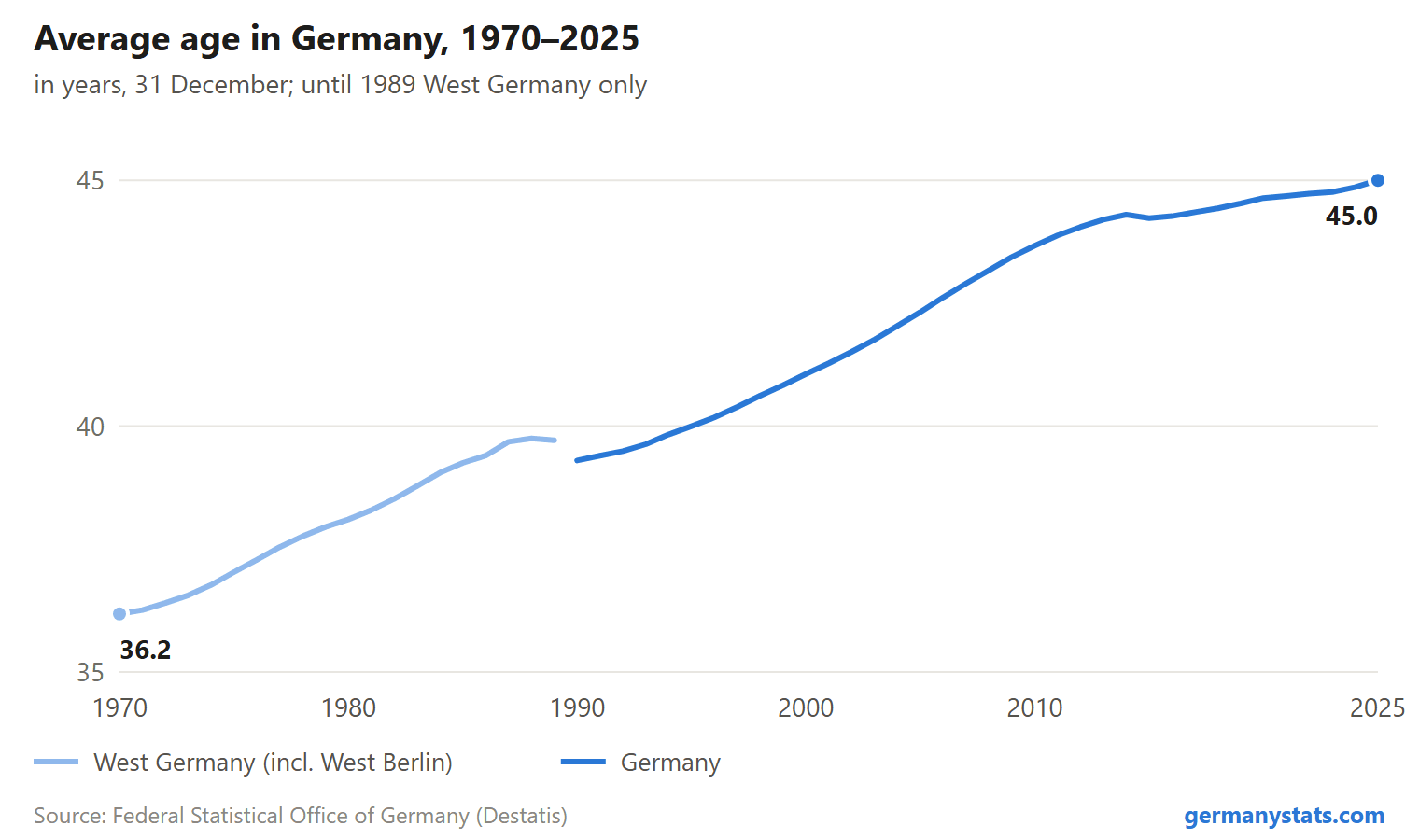
In short: The average age of Germany's population was 45.0 years at the end of 2025 – 46.3 for women and 43.6 for men. In 1970 it was 36.2. Half of the population is older than 45.6 years (median age).
Average age in Germany since 1970
Germany's population has been ageing for decades: low birth rates since the early 1970s and rising life expectancy push the average age up. In West Germany it rose from 36.2 (1970) to 39.7 (1989); for Germany as a whole from 39.3 in 1990 to 45.0 in 2025. Immigration of young people has slowed the increase since 2015.
Average age by district
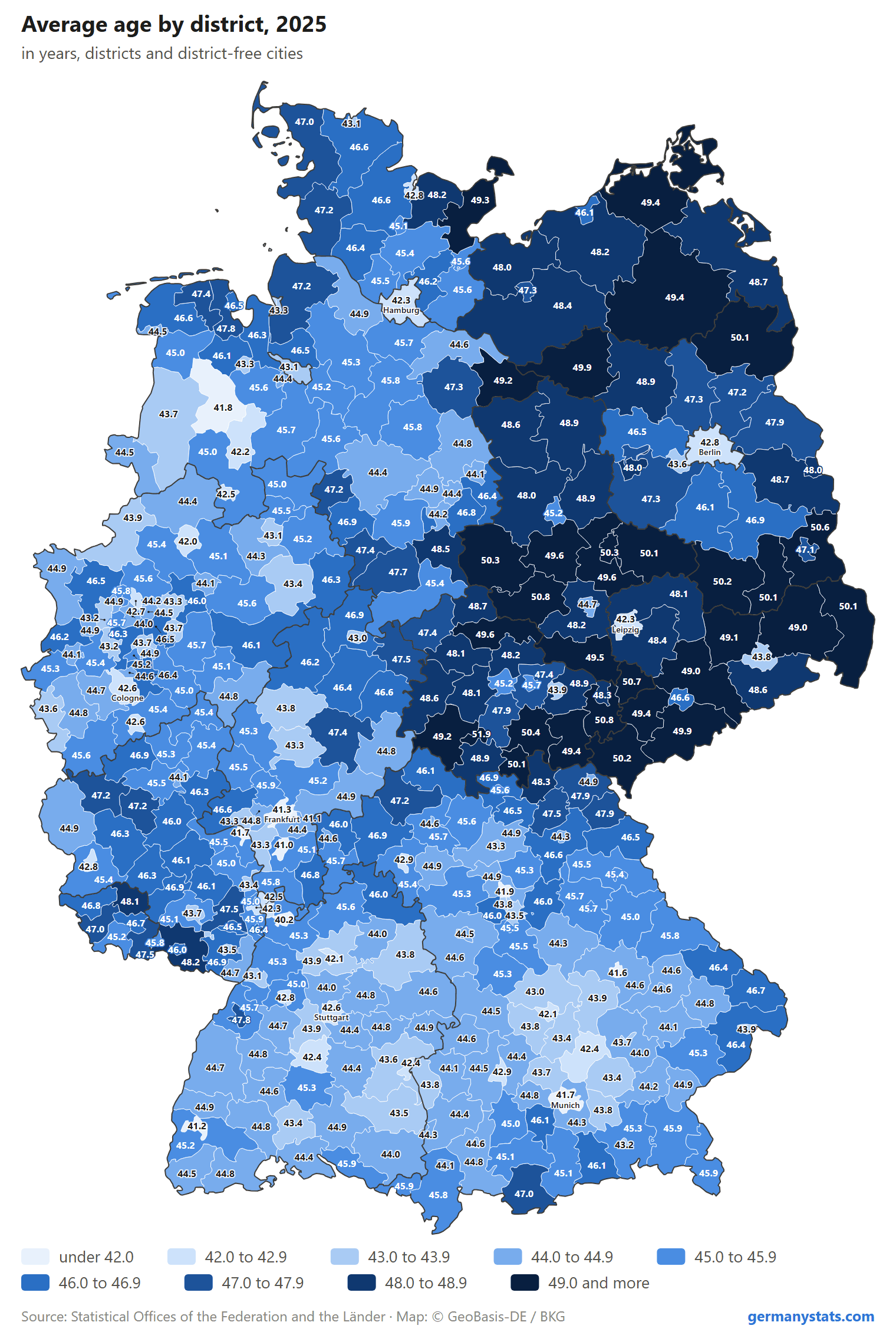
The oldest regions are in eastern Germany, where many young people moved away after 1990: Suhl (51.9), Mansfeld-Südharz district (50.8) and Greiz district (50.8). The youngest are university cities and economically strong regions such as Heidelberg (40.2), Darmstadt (41.0) and Offenbach am Main (41.1).
Average age by federal state
| State | Average age 2025 |
|---|---|
| Saxony-Anhalt | 48.4 |
| Mecklenburg-Western Pomerania | 48.3 |
| Thuringia | 48.2 |
| Brandenburg | 47.7 |
| Saxony | 47.2 |
| Saarland | 46.5 |
| Schleswig-Holstein | 46.0 |
| Rhineland-Palatinate | 45.3 |
| Lower Saxony | 45.2 |
| North Rhine-Westphalia | 44.6 |
| Hesse | 44.4 |
| Bavaria | 44.4 |
| Baden-Württemberg | 44.2 |
| Bremen | 43.2 |
| Berlin | 42.8 |
| Hamburg | 42.3 |
Frequently asked questions
What is the average age in Germany?
45.0 years at the end of 2025: 46.3 for women and 43.6 for men.
What is the median age in Germany?
45.6 years – half of the population is younger, half older.
Which German state is the oldest?
Saxony-Anhalt with an average age of 48.4; the youngest is Hamburg (42.3).