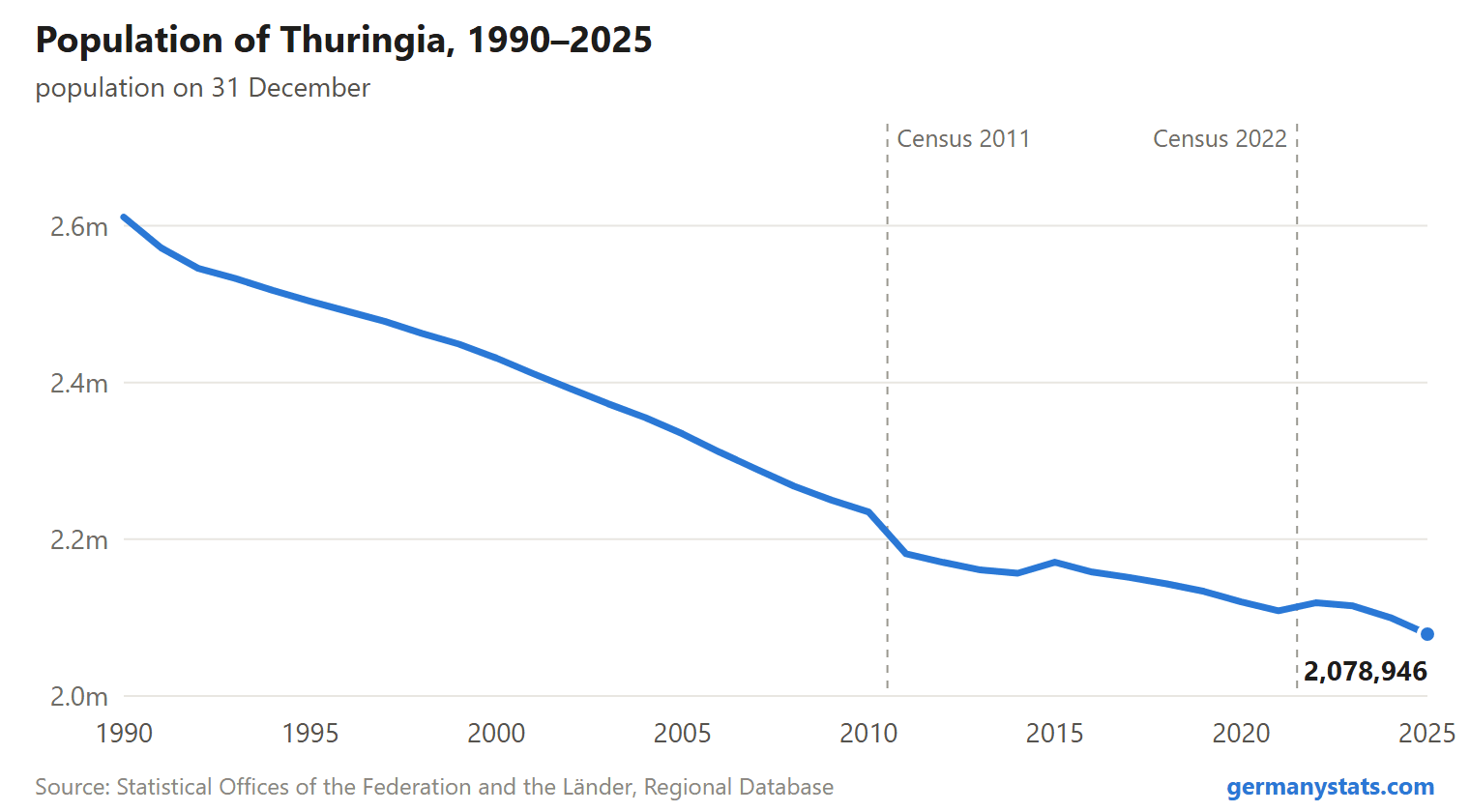
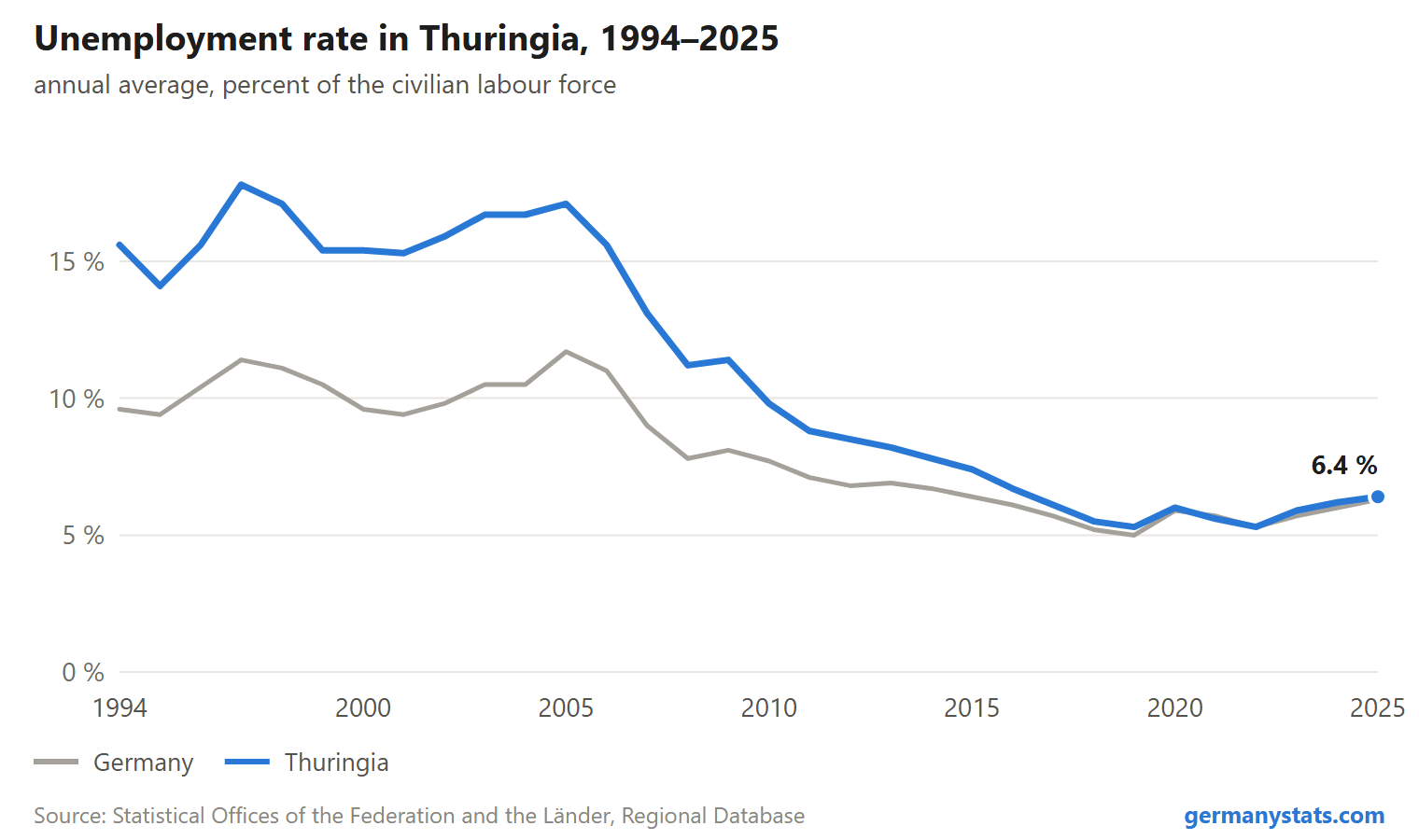
In short: Thuringia had 2,078,946 inhabitants on 31 December 2025, making it number 12 of the 16 German states by population. Since 1990 the population has fallen by 20.4 % (Germany: +4.7 %). The average age is 48.2 years, 8.4 % of residents are foreign nationals and the unemployment rate was 6.4 % in 2025.
Population of Thuringia
Thuringia had 2,078,946 inhabitants at the end of 2025, 50.6 % of them women; in 1990 there were 2,611,319. The population peaked at 2,611,319 in 1990. The largest cities and districts are Erfurt (217,159), Wartburgkreis (153,346), Gotha district (134,460). The breaks in 2011 and 2022 are due to the censuses.
Thuringia in maps: age and foreign nationals by district
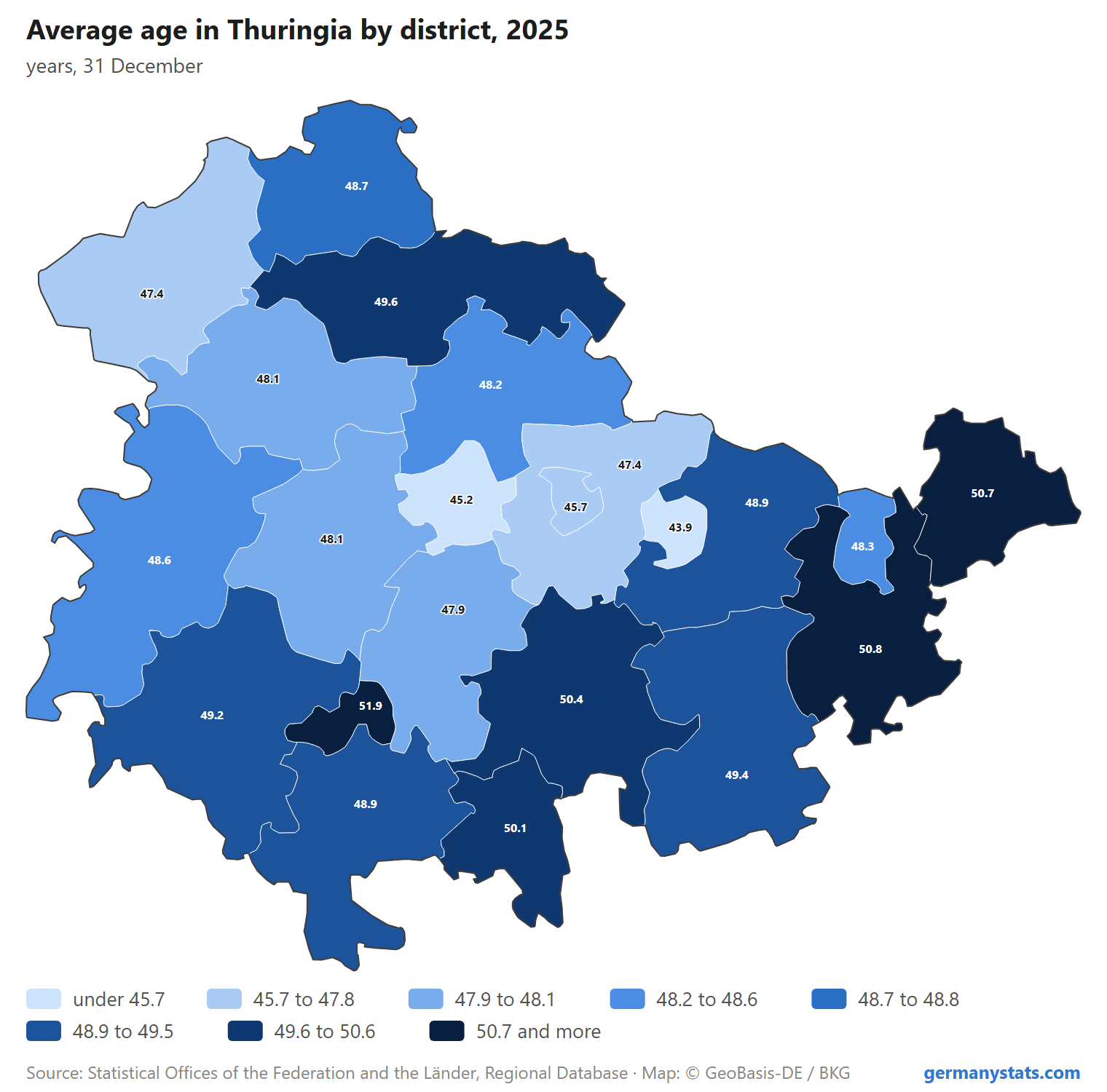
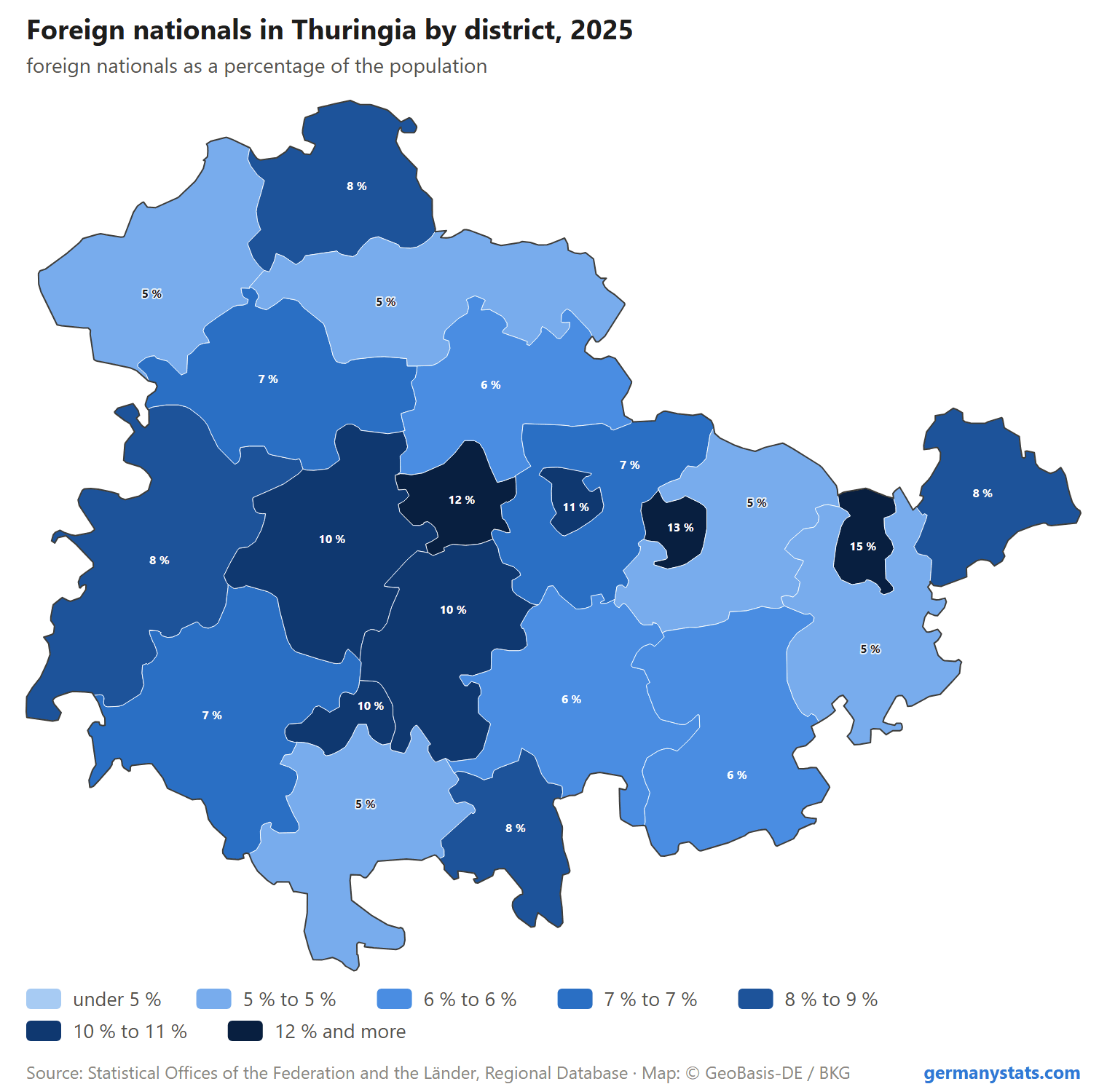
The youngest populations are in Jena (43.9 years) and Erfurt (45.2 years), the oldest in Suhl (51.9 years). The share of foreign nationals is highest in Gera (14.8 %) and lowest in Greiz district (4.8 %).
All districts and independent cities in Thuringia
Thuringia has 5 independent cities and 17 districts. The table shows key figures; major cities have their own pages with all statistics.
| District / city | Population 2025 | Average age | Foreign nationals | Unemployment | Bürgergeld |
|---|---|---|---|---|---|
| Erfurt (city) | 217,159 | 45.2 | 12.3 % | 6.3 % | 6.3 % |
| Wartburgkreis | 153,346 | 48.6 | 7.8 % | 6.0 % | 4.6 % |
| Gotha (district) | 134,460 | 48.1 | 9.8 % | 6.6 % | 5.1 % |
| Schmalkalden-Meiningen (district) | 118,927 | 49.2 | 7.0 % | 5.1 % | 3.4 % |
| Jena (city) | 109,353 | 43.9 | 12.5 % | 6.1 % | 5.0 % |
| Ilm-Kreis | 106,006 | 47.9 | 10.2 % | 6.4 % | 5.4 % |
| Eichsfeld (district) | 102,772 | 47.4 | 5.3 % | 4.4 % | 3.4 % |
| Saalfeld-Rudolstadt (district) | 98,386 | 50.4 | 5.5 % | 6.2 % | 5.5 % |
| Gera (city) | 95,162 | 48.3 | 14.8 % | 10.3 % | 10.8 % |
| Unstrut-Hainich-Kreis | 93,553 | 48.1 | 6.6 % | 7.4 % | 6.9 % |
| Greiz (district) | 92,479 | 50.8 | 4.8 % | 6.0 % | 4.2 % |
| Altenburger Land (district) | 86,712 | 50.7 | 8.3 % | 9.3 % | 8.4 % |
| Saale-Holzland-Kreis | 82,163 | 48.9 | 5.4 % | 5.0 % | 3.4 % |
| Weimarer Land (district) | 81,766 | 47.4 | 6.7 % | 4.7 % | 4.8 % |
| Nordhausen (district) | 79,695 | 48.7 | 8.2 % | 8.2 % | 7.6 % |
| Saale-Orla-Kreis | 76,188 | 49.4 | 5.8 % | 5.7 % | 4.3 % |
| Kyffhäuserkreis | 70,635 | 49.6 | 5.4 % | 8.3 % | 7.1 % |
| Sömmerda (district) | 67,106 | 48.2 | 5.8 % | 6.2 % | 5.0 % |
| Weimar (city) | 65,566 | 45.7 | 11.5 % | 6.3 % | 6.4 % |
| Hildburghausen (district) | 59,287 | 48.9 | 5.3 % | 4.6 % | 3.1 % |
| Sonneberg (district) | 54,249 | 50.1 | 8.4 % | 5.4 % | 3.6 % |
| Suhl (city) | 33,976 | 51.9 | 9.8 % | 7.2 % | 4.7 % |
Age structure and young adults
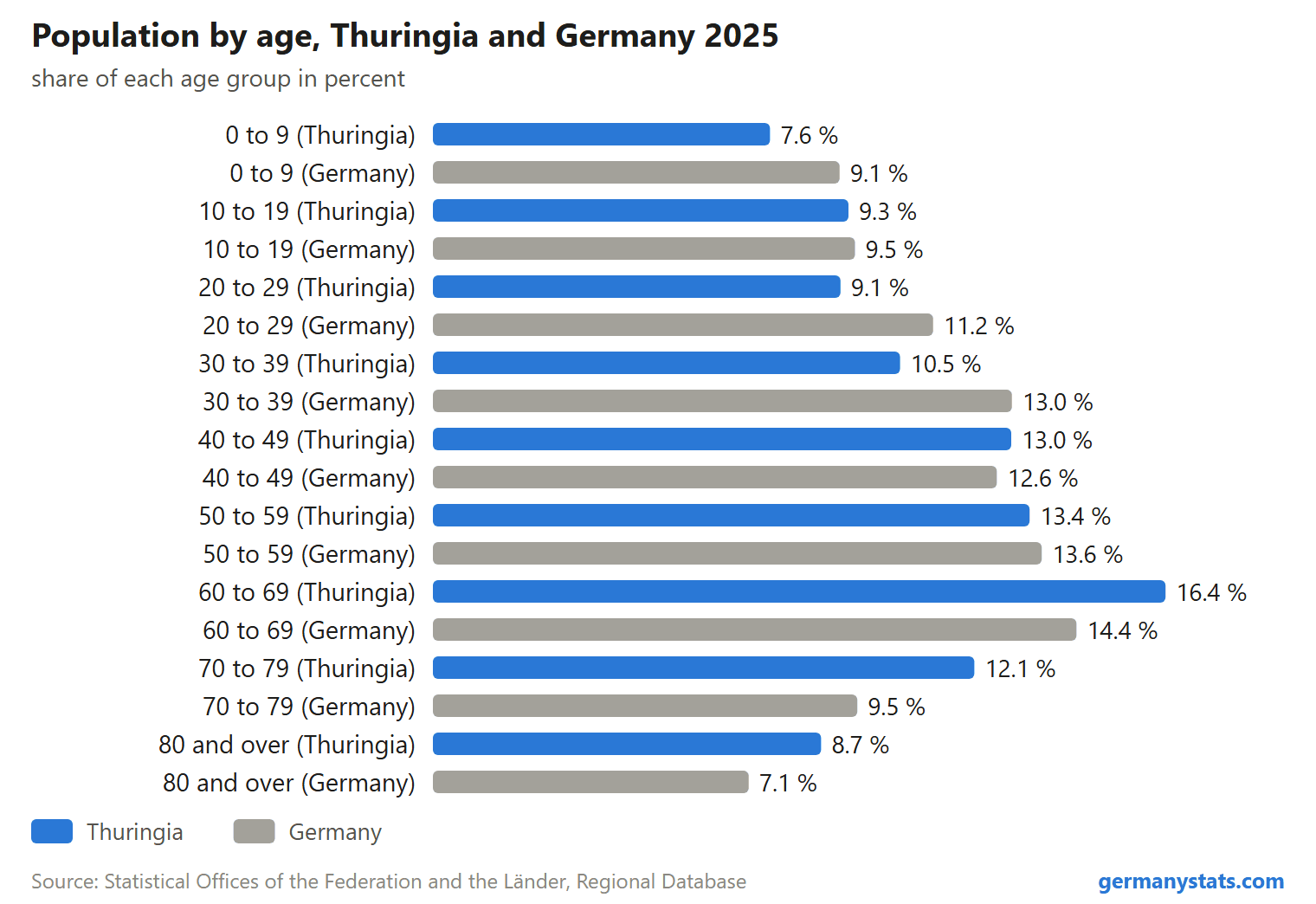
The average age in Thuringia was 48.2 years in 2025 – 3.2 years above the national average. 19.6 % of residents are aged 20 to 39 (Germany: 24.2 %), 8.7 % are 80 or older (Germany: 7.1 %). Among 20- to 29-year-olds there were 115.8 men per 100 women in 2025 (Germany: 109.5).

Jobs, income and foreign nationals in Thuringia
The unemployment rate was 6.4 % in 2025 (Germany: 6.3 %). At the end of 2024, 114,772 people received Bürgergeld (basic income support), 5.5 % of residents. Disposable income was €26,497 per resident in 2024 (Germany: €30,069), GDP €36,890 per resident (Germany: €51,834). The share of foreign nationals rose from 1.0 % (1995) to 8.4 % (2025).
Federal election 2025 in Thuringia
Turnout in Thuringia at the 2025 federal election was 80.7 %. The AfD won the most second votes with 38.6 %, ahead of the CDU/CSU with 18.6 %.
| Party | Second votes 2025 | Second votes 2021 |
|---|---|---|
| AfD | 38.6 % | 24.0 % |
| CDU/CSU | 18.6 % | 16.9 % |
| The Left | 15.2 % | 11.4 % |
| SPD | 8.8 % | 23.4 % |
| Greens | 4.2 % | 6.6 % |
| FDP | 2.8 % | 9.0 % |
Major cities in Thuringia
Frequently asked questions about Thuringia
What is the population of Thuringia?
Thuringia had 2,078,946 inhabitants on 31 December 2025.
What share of Thuringia's population are foreigners?
8.4 % (end of 2025).
What is the unemployment rate in Thuringia?
The annual average unemployment rate was 6.4 % in 2025.
How many districts does Thuringia have?
17 districts and 5 independent cities.