In short: SECO reports an unemployment rate of 3.0% for October 2026 (141,015 registered unemployed). Using the international ILO definition applied by Eurostat and the Federal Statistical Office, it was 5.6% in Q3 2026 (288,000 unemployed). The ILO rate averaged 4.9% in 2025, below the EU average of 6.0%.
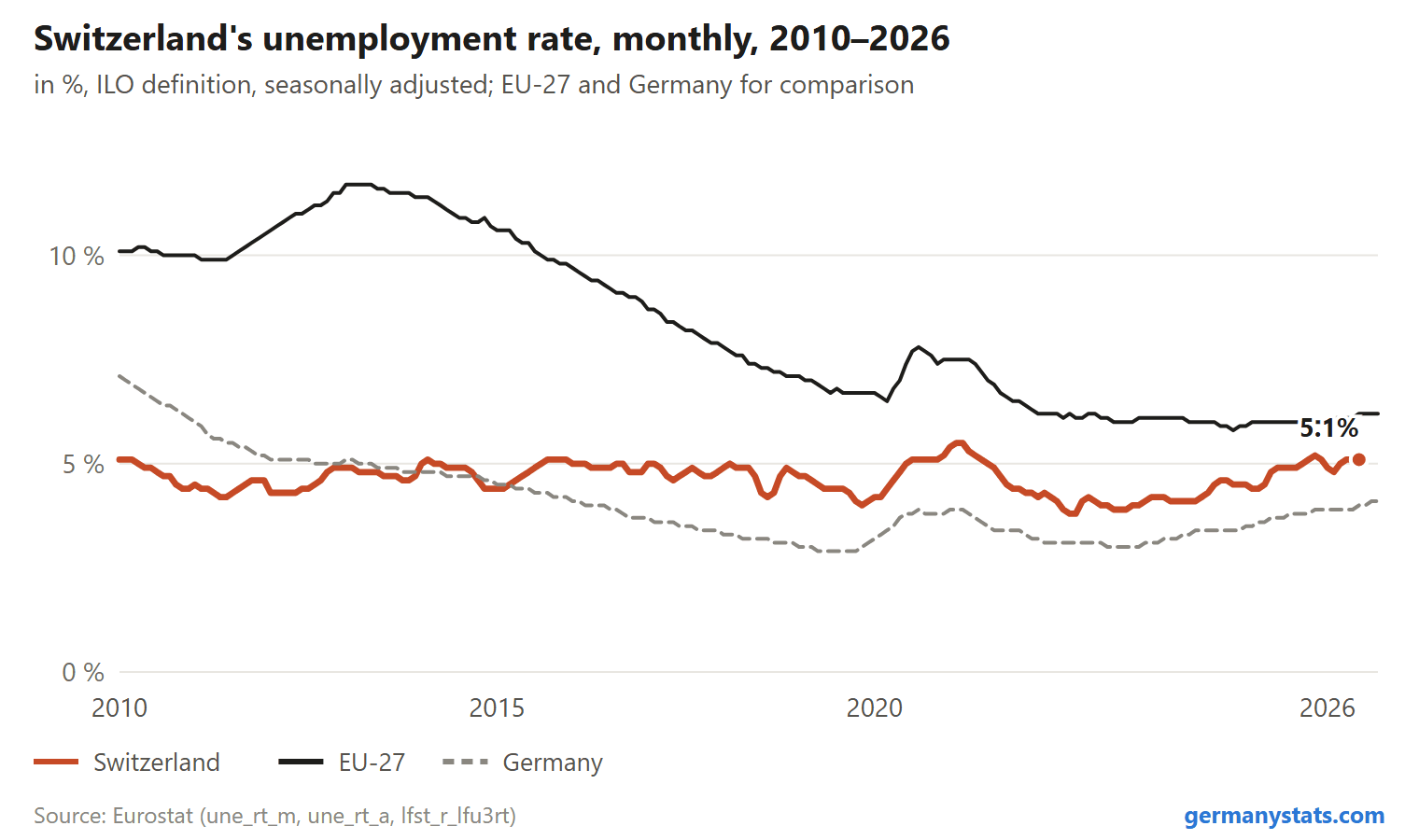
Switzerland's unemployment rate since 2010
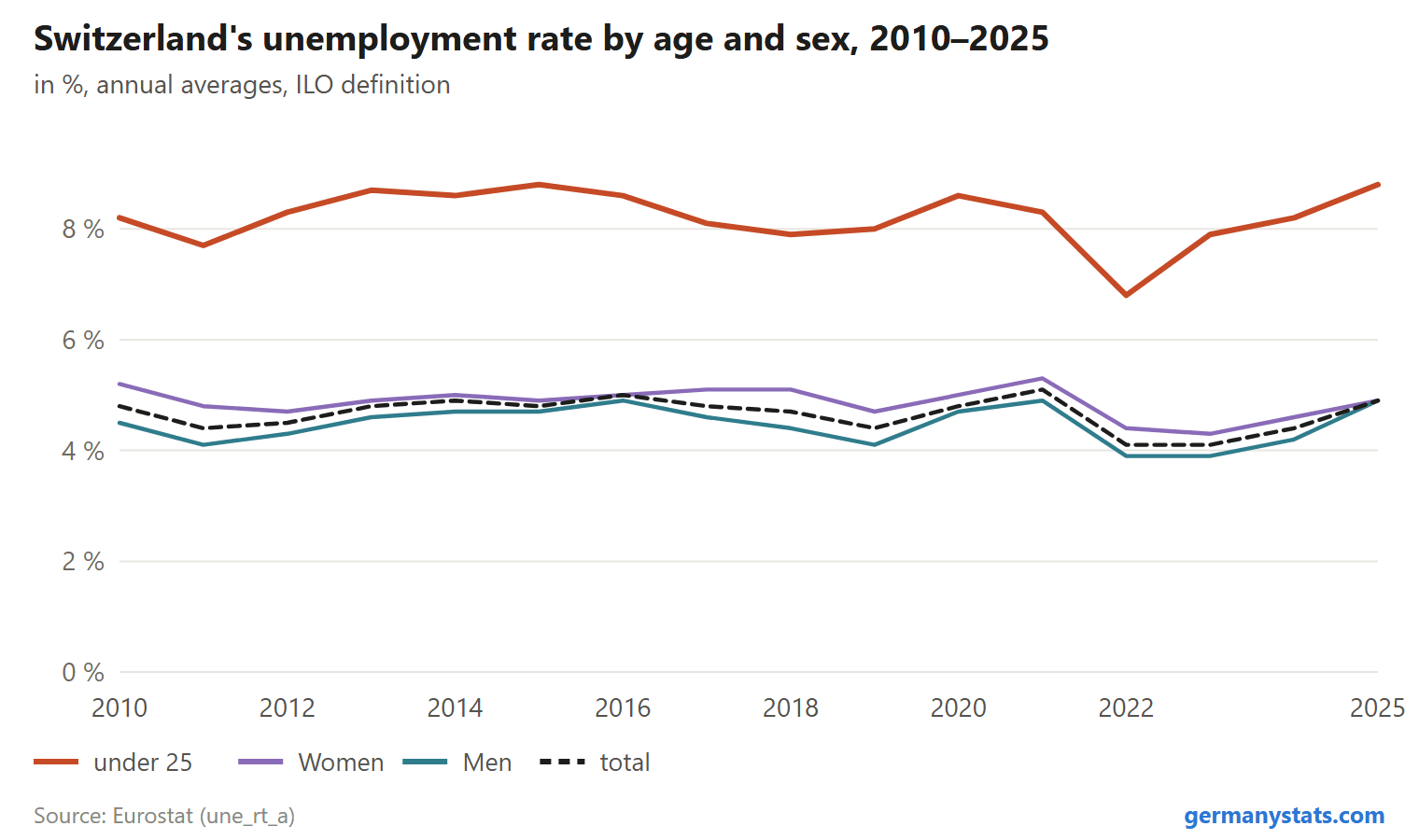
Since 2010, Switzerland's ILO rate has ranged between 3.8% (August 2022) and 5.5% (February 2021). The peak came with the COVID-19 crisis: despite short-time work, employees in hospitality and tourism in particular lost their jobs. In 2022 the rate fell to the lowest level since the monthly series began, helped by the post-pandemic recovery and labour shortages. It has been rising again since 2023: weak demand from Germany, the strong franc and, in 2025, high US tariffs on Swiss goods weighed on export industries, especially machinery and watches. In Q3 2026, the FSO's ILO rate of 5.6% was back at its pandemic level (same quarter a year earlier: 5.1%).
Unemployment by region in Switzerland
Unemployment is much higher in the French- and Italian-speaking parts of Switzerland than in the German-speaking part. It is highest in the Lake Geneva region (7.8%) and Ticino (6.6%), and lowest in Central Switzerland (3.0%) and Eastern Switzerland (3.3%). Reasons include proximity to the French and Italian labour markets with higher unemployment, many cross-border commuters competing for jobs, and a higher share of jobs in hospitality and retail. SECO's registered rate is also highest in Geneva (5.3%), while Appenzell Innerrhoden has the lowest (0.8%).
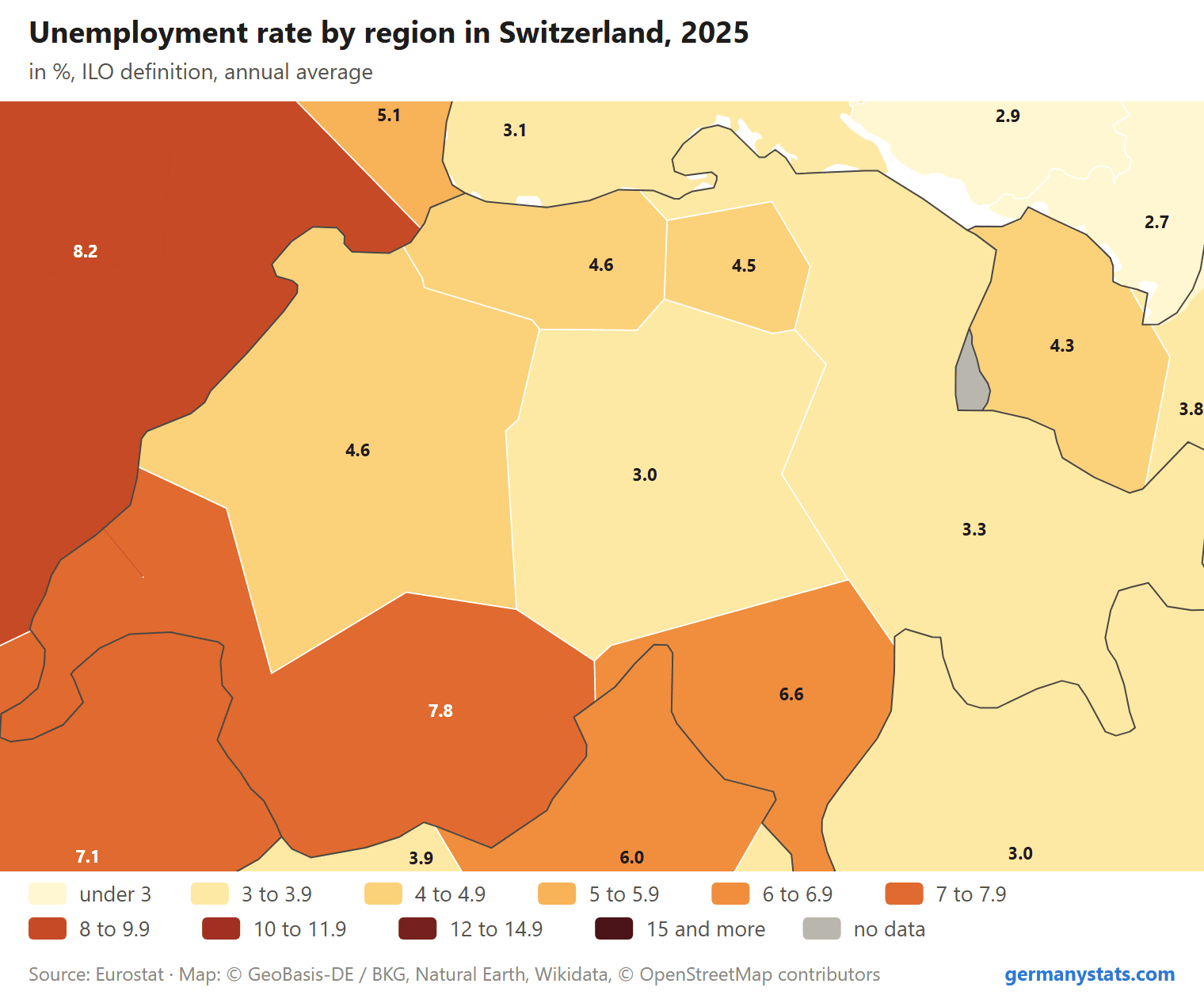
| Region | Rate 2025 | Under 25 | 2015 | Change |
|---|---|---|---|---|
| Région lémanique | 7.8% | 14.7% | 7.5% | +0.3 pts |
| Ticino | 6.6% | 14.9% | 6.9% | -0.3 pts |
| Espace Mittelland | 4.6% | 8.5% | 4.4% | +0.2 pts |
| Nordwestschweiz | 4.6% | 7.5% | 4.3% | +0.3 pts |
| Zürich | 4.5% | 8.2% | 4.1% | +0.4 pts |
| Ostschweiz | 3.3% | 5.4% | 4.0% | -0.7 pts |
| Zentralschweiz | 3.0% | 4.5% | 3.4% | -0.4 pts |
Annual averages; under 25: aged 15 to 24 where the sample is large enough.
SECO rate or ILO rate: why there are two unemployment rates
SECO (State Secretariat for Economic Affairs): counts everyone registered with a Regional Employment Centre (RAV/ORP) who has no job and is available for placement: 141,015 in October 2026, a rate of 3.0% (seasonally adjusted 3.1%). FSO and Eurostat (ILO): based on the Swiss Labour Force Survey (SLFS). Unemployed means without work, looking for work in the past four weeks and able to start soon, whether registered or not: 288,000 people or 5.6% in Q3 2026. The ILO rate is higher because many jobseekers do not register: people with no entitlement to unemployment benefit, such as those whose benefits have run out, school leavers or people returning to work after a family break, have little reason to. In Germany it is the other way round: the national rate is above the ILO rate (see Germany unemployment rate). Only the ILO rate is suitable for international comparisons.
Youth unemployment in Switzerland
Among 15 to 24-year-olds, the ILO rate was 8.8% in 2025, far below the EU average (15.2%). Thanks to vocational apprenticeships, most young people move straight from school into a company. SECO's youth rate is even lower at 3.2%, because young jobseekers without benefit entitlement rarely register with the RAV. In 2025, 4.9% of women and 4.9% of men in the labour force were unemployed.
For a comparison of all European countries and regions with a map, see Unemployment rate in Europe. More countries: Spain unemployment rate, France unemployment rate and Germany unemployment rate.
Related: Unemployment Rate in Europe, Unemployment rate in Germany and France Unemployment Rate.
Frequently asked questions
What is the unemployment rate in Switzerland?
SECO's registered unemployment rate was 3.0% in October 2026 (141,015 people). The ILO rate measured by the FSO was 5.6% in Q3 2026; the annual average for 2025 according to Eurostat was 4.9%.
Why are there two unemployment rates in Switzerland?
SECO counts people registered with the employment centres (RAV). The FSO and Eurostat survey households using the ILO definition, which also includes jobseekers who are not registered. That is why the ILO rate is about two percentage points higher.
Which region of Switzerland has the highest unemployment?
The Lake Geneva region (7.8% in 2025, ILO) and Ticino. Among the cantons, Geneva has the highest registered rate (5.3%, October 2026).
How does Switzerland compare with Germany?
By the ILO definition, Switzerland (4.9%) is above Germany (3.8%) in 2025. By the national figures it is the other way round: SECO 3.0%, German Federal Employment Agency over 6%.