In short: At the start of 2025 there were 106.9 men per 100 women aged 20 to 29 in the EU. Germany is above that at 109.6, ranking 8 of 36 countries. Malta has the largest male surplus (133.8); there are more young women than men in Albania (95.8) and Moldova (91.4).
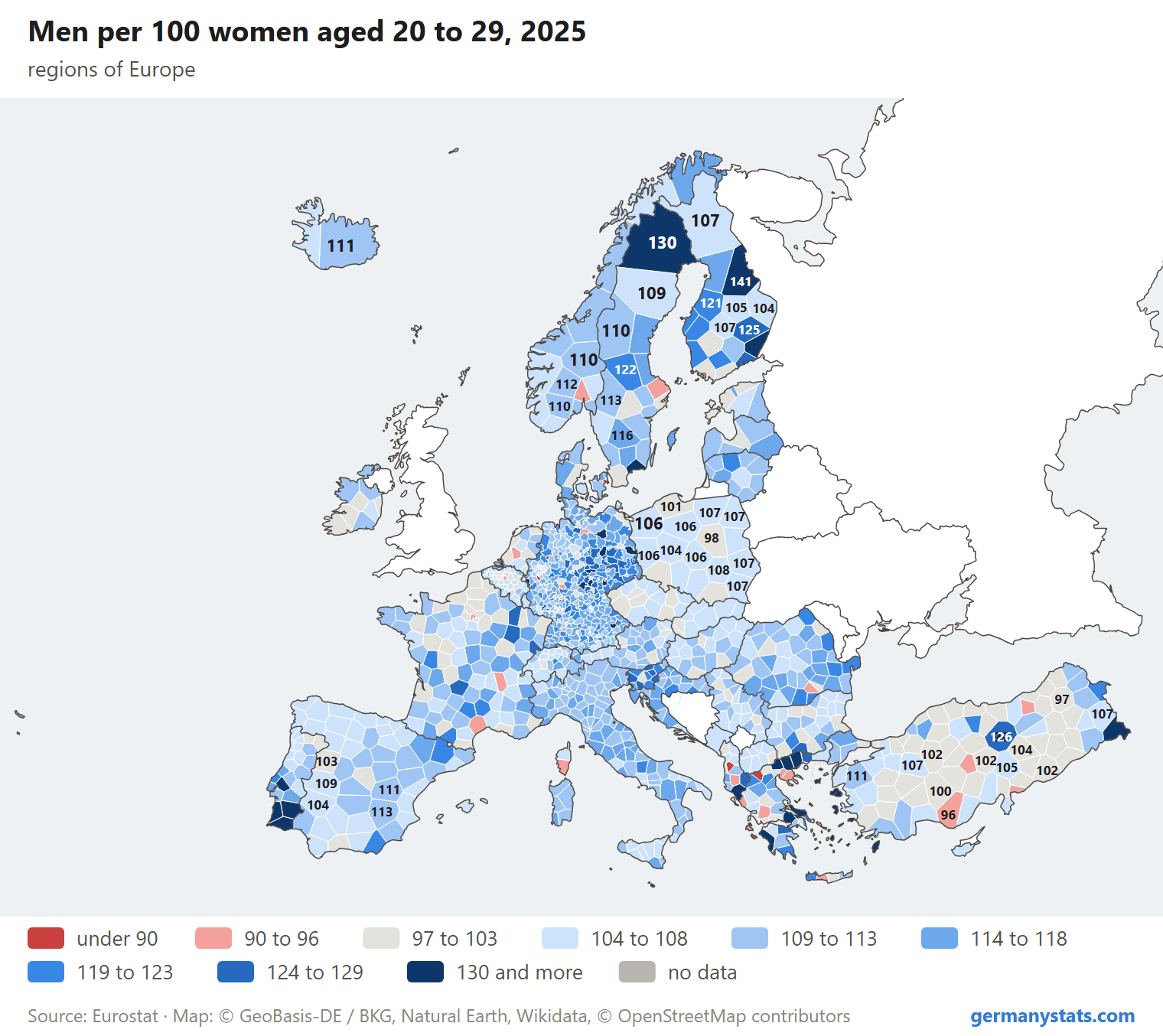
Map of Europe: men per 100 women aged 20 to 29
Blue regions have more young men than women, red ones more young women. In 1,050 of 1,238 regions there are more than 103 men per 100 young women, in 49 fewer than 97. The pattern is similar everywhere: university cities attract young women, while rural regions, industrial locations and regions with many immigrants have more young men. The far north of Sweden and Finland, large parts of Germany and some regions of Greece and Portugal stand out.
Detailed maps with figures for all regions
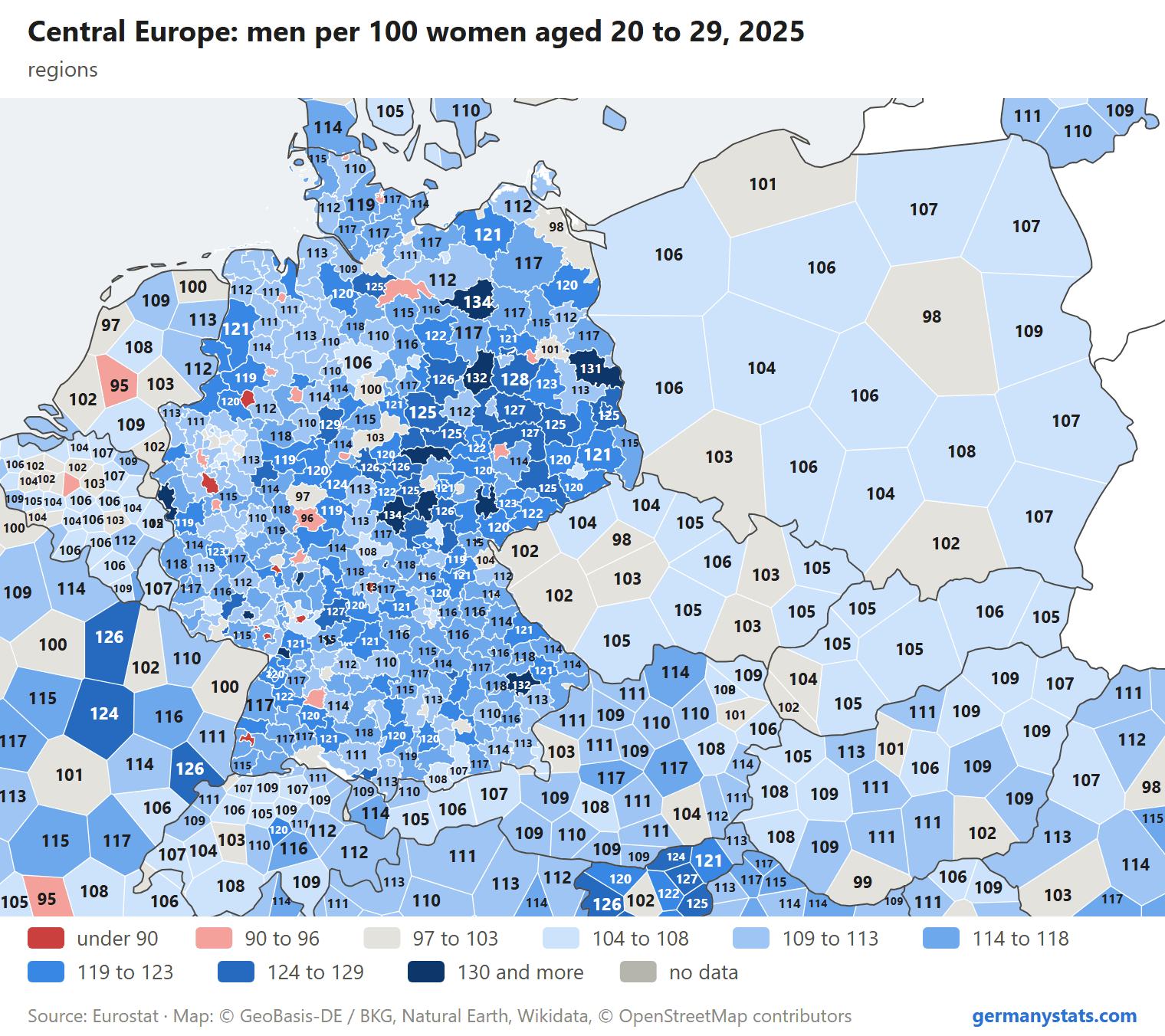
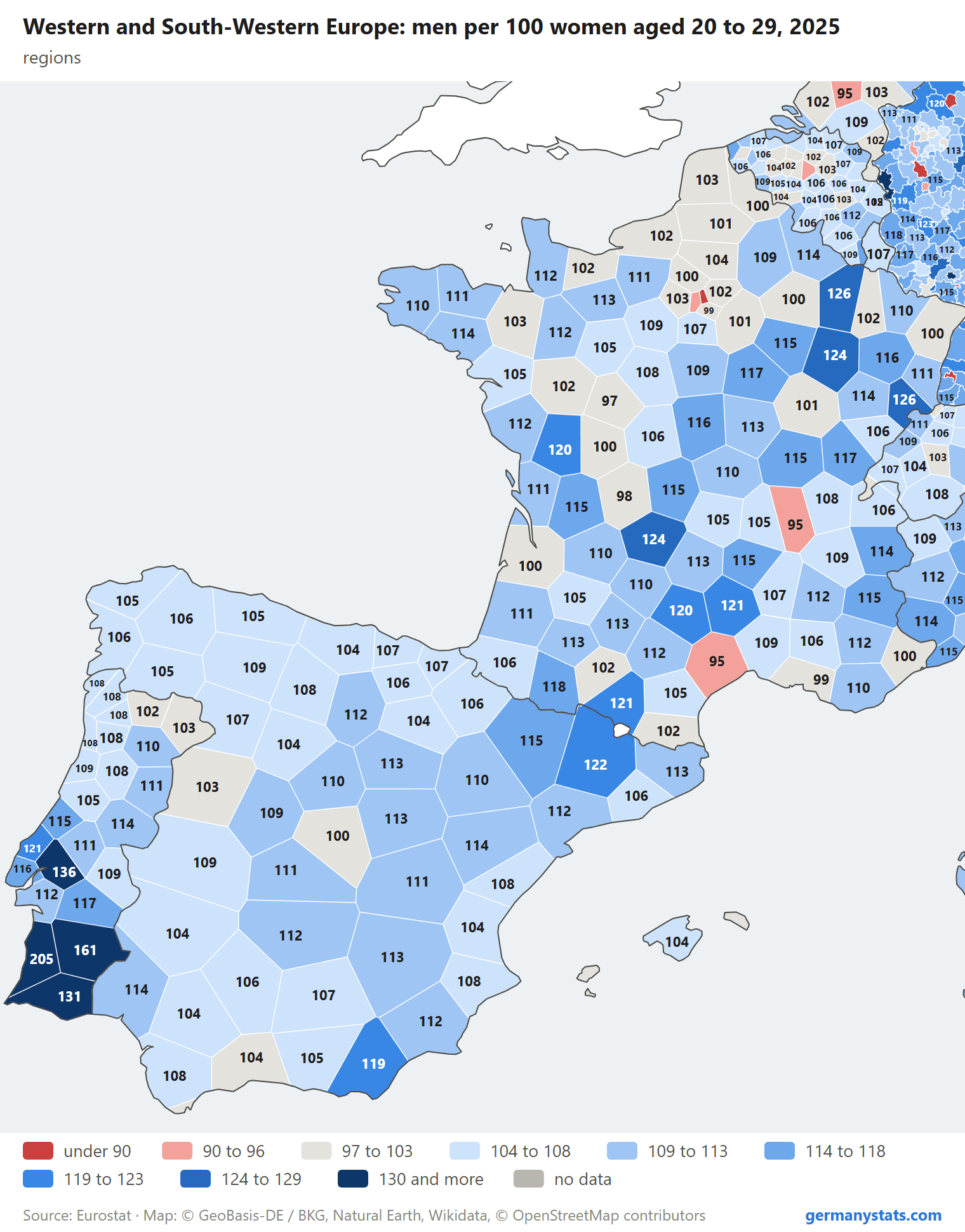
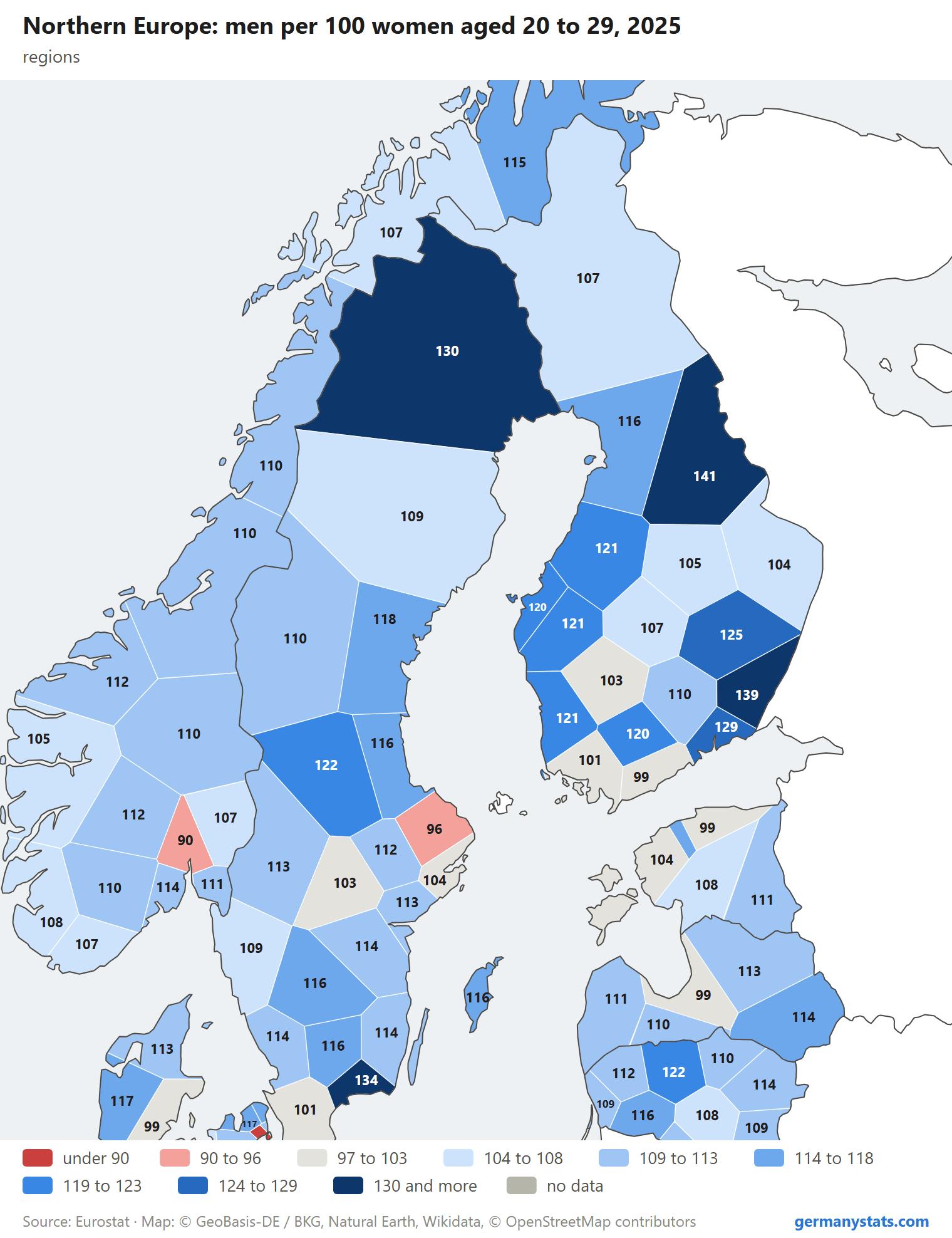
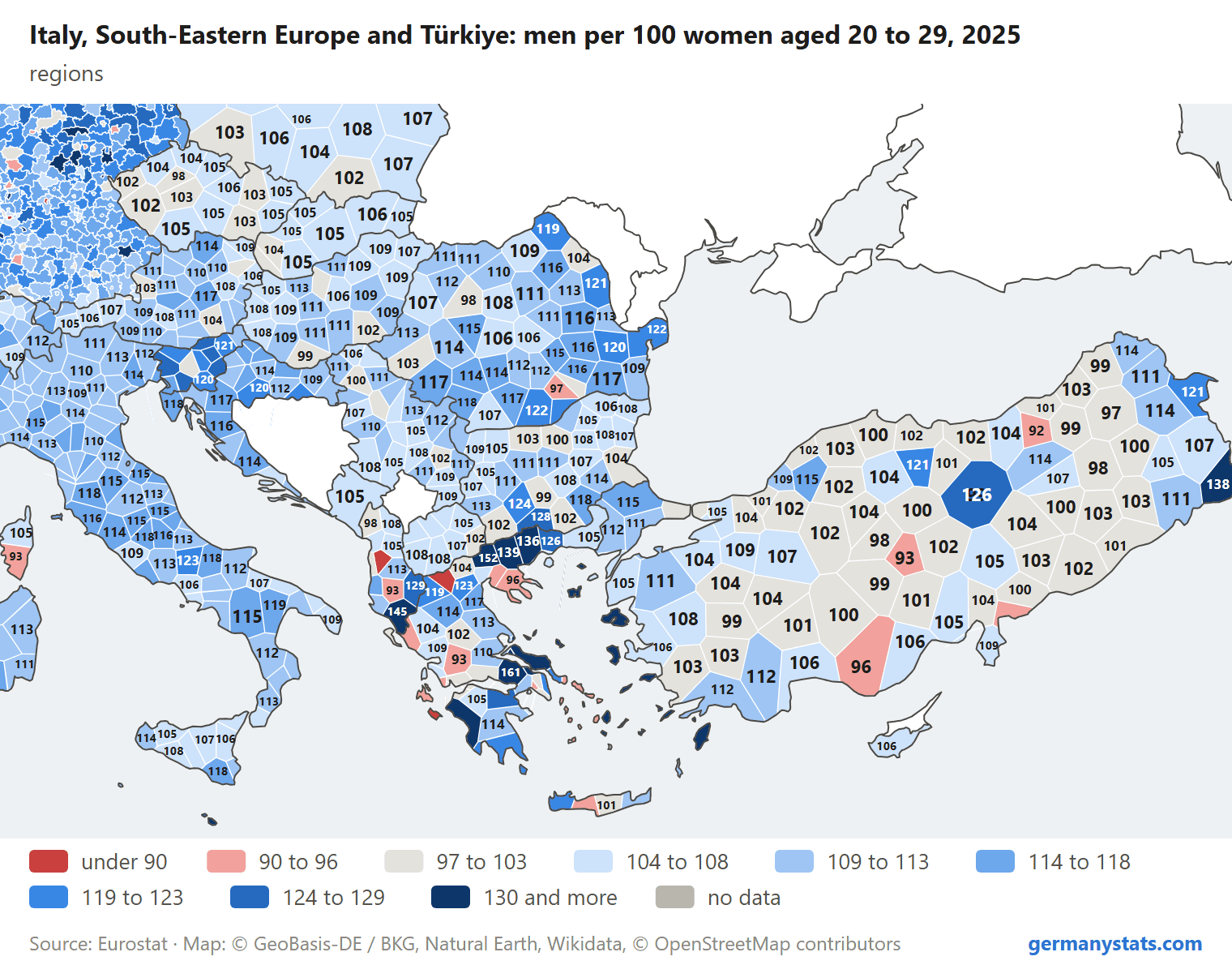
Figures for all 400 German districts are shown on the map on Gender ratio in Germany.
Gender ratio in Europe: countries compared
The male surplus among young adults is largest in Malta (133.8), Slovenia (115.1), Portugal (113.7), Croatia (113.0) and Greece (112.0). Malta has many young male workers from abroad, for example in construction and tourism; in Slovenia, Croatia and Portugal young women are also more likely to move abroad to study or work. The most balanced, or with more women, are Moldova (91.4), Albania (95.8), France (102.3), Netherlands (103.0) and Czechia (103.3). In Moldova and Albania many young men emigrate for work. Germany ranks 8 with 109.6 men per 100 women, well above the EU average of 106.9.
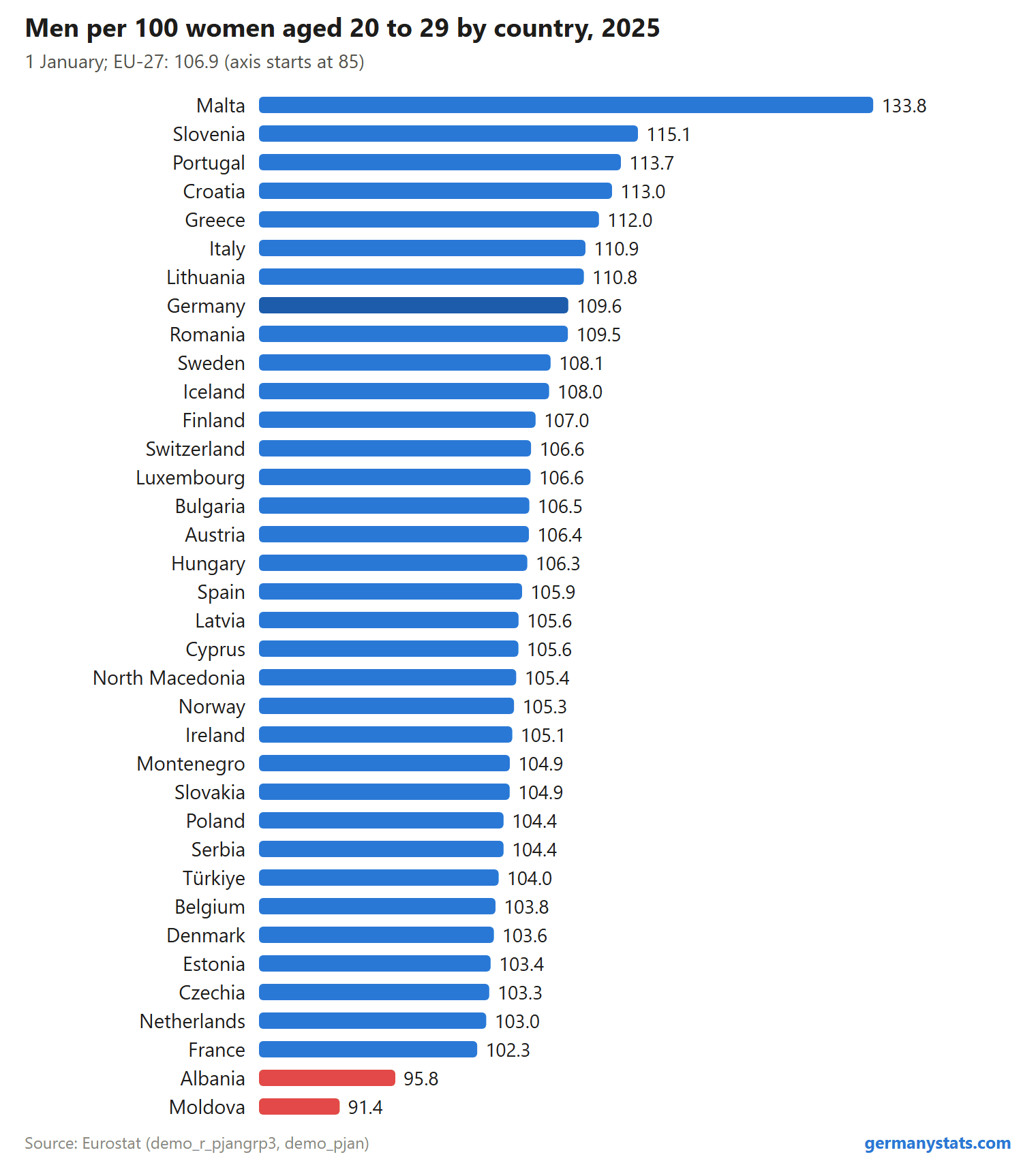
| Country | Men per 100 women 2025 | 2015 | Young men | Young women |
|---|---|---|---|---|
| Malta | 133.8 | 108.1 | 46,773 | 34,968 |
| Slovenia | 115.1 | 106.9 | 115,067 | 99,984 |
| Portugal | 113.7 | 100.7 | 718,872 | 632,057 |
| Croatia | 113.0 | 101.9 | 228,748 | 202,386 |
| Greece | 112.0 | 102.6 | 559,867 | 499,908 |
| Italy | 110.9 | 103.4 | 3,166,036 | 2,854,260 |
| Lithuania | 110.8 | 103.8 | 154,434 | 139,391 |
| Germany | 109.6 | 105.6 | 4,886,588 | 4,460,553 |
| Romania | 109.5 | 108.4 | 1,050,192 | 958,916 |
| Sweden | 108.1 | 105.0 | 636,336 | 588,405 |
| Iceland | 108.0 | 105.0 | 28,268 | 26,168 |
| Finland | 107.0 | 104.8 | 336,994 | 315,059 |
| Switzerland | 106.6 | 102.7 | 534,678 | 501,552 |
| Luxembourg | 106.6 | 104.0 | 46,692 | 43,818 |
| Bulgaria | 106.5 | 106.9 | 286,167 | 268,808 |
| Austria | 106.4 | 103.5 | 556,108 | 522,531 |
| Hungary | 106.3 | 106.0 | 540,589 | 508,548 |
| Spain | 105.9 | 102.1 | 2,772,820 | 2,618,782 |
| Latvia | 105.6 | 105.7 | 87,041 | 82,424 |
| Cyprus | 105.6 | 107.2 | 60,938 | 57,708 |
| North Macedonia | 105.4 | 105.2 | 109,867 | 104,221 |
| Norway | 105.3 | 104.6 | 360,803 | 342,796 |
| Ireland | 105.1 | 97.3 | 334,527 | 318,272 |
| Montenegro | 104.9 | 106.4 | 36,464 | 34,757 |
| Slovakia | 104.9 | 104.0 | 280,885 | 267,747 |
| Poland | 104.4 | 104.1 | 1,891,492 | 1,811,557 |
| Serbia | 104.4 | 105.0 | 354,007 | 339,049 |
| Türkiye | 104.0 | 103.3 | 6,571,678 | 6,317,568 |
| Belgium | 103.8 | 101.1 | 733,149 | 706,477 |
| Denmark | 103.6 | 103.8 | 399,503 | 385,435 |
| Estonia | 103.4 | 107.0 | 69,157 | 66,890 |
| Czechia | 103.3 | 104.8 | 538,267 | 521,176 |
| Netherlands | 103.0 | 102.3 | 1,202,200 | 1,166,750 |
| France | 102.3 | 99.4 | 3,990,756 | 3,900,203 |
| Albania | 95.8 | 113.4 | 132,116 | 137,884 |
| Moldova | 91.4 | 101.8 | 100,554 | 110,010 |
| EU-27 | 106.9 | 103.4 | 25,690,198 | 24,033,013 |
Regions with the most and fewest young men
The highest values in Europe are found in Evros (Greece, 249), Lesvos, Limnos (Greece, 236) and Alentejo Litoral (Portugal, 205). The Greek border region of Evros and the Aegean islands are home to reception centres for refugees at the EU's external border, where mainly young men live. In Portugal's Alentejo many young men from South Asia work in agriculture. In Germany, small university and industrial towns with technical courses stand out, such as the Ilm-Kreis with TU Ilmenau. Relatively the most young women live in university cities: Freiburg im Breisgau (Germany, 79), Tiranë (Albania, 80), Paris (France, 82), Münster (Germany, 83) and Würzburg (Germany, 85).
The 15 regions with the largest male surplus
| Rank | Region | Country | Men per 100 women | People aged 20–29 |
|---|---|---|---|---|
| 1 | Evros | Greece | 249 | 20,966 |
| 2 | Lesvos, Limnos | Greece | 236 | 16,595 |
| 3 | Alentejo Litoral | Portugal | 205 | 16,192 |
| 4 | Kalymnos, Karpathos, Iroiki Nisos Kasos, Kos, Rodos | Greece | 181 | 27,086 |
| 5 | Voiotia | Greece | 161 | 11,054 |
| 6 | Baixo Alentejo | Portugal | 161 | 14,538 |
| 7 | Ileia | Greece | 147 | 15,440 |
| 8 | Serres | Greece | 139 | 16,268 |
| 9 | Etelä-Karjala | Finland | 139 | 13,424 |
| 10 | Hakkari | Türkiye | 138 | 64,777 |
| 11 | Lezíria do Tejo | Portugal | 136 | 30,553 |
| 12 | Heilbronn | Germany | 136 | 18,533 |
| 13 | Malta | Malta | 134 | 76,630 |
| 14 | Darmstadt | Germany | 134 | 32,049 |
| 15 | Blekinge län | Sweden | 134 | 16,464 |
The 15 regions with the most young women
| Rank | Region | Country | Men per 100 women | People aged 20–29 |
|---|---|---|---|---|
| 1 | Freiburg im Breisgau | Germany | 79 | 45,038 |
| 2 | Tiranë | Albania | 80 | 108,417 |
| 3 | Paris | France | 82 | 380,500 |
| 4 | Münster | Germany | 83 | 60,680 |
| 5 | Würzburg | Germany | 85 | 27,242 |
| 6 | Heidelberg | Germany | 87 | 35,562 |
| 7 | Byen København | Denmark | 88 | 182,773 |
| 8 | Mainz | Germany | 89 | 42,393 |
| 9 | Köln | Germany | 90 | 148,121 |
| 10 | Rethymni | Greece | 90 | 10,459 |
| 11 | Osnabrück | Germany | 90 | 30,444 |
| 12 | Oslo | Norway | 90 | 121,856 |
| 13 | Tübingen | Germany | 90 | 38,061 |
| 14 | Düsseldorf | Germany | 91 | 81,708 |
| 15 | Bonn | Germany | 92 | 50,080 |
Only regions with at least 10,000 residents aged 20 to 29; values fluctuate strongly in very small regions. Poland and the Netherlands: voivodeships and provinces.
Trend since 1991
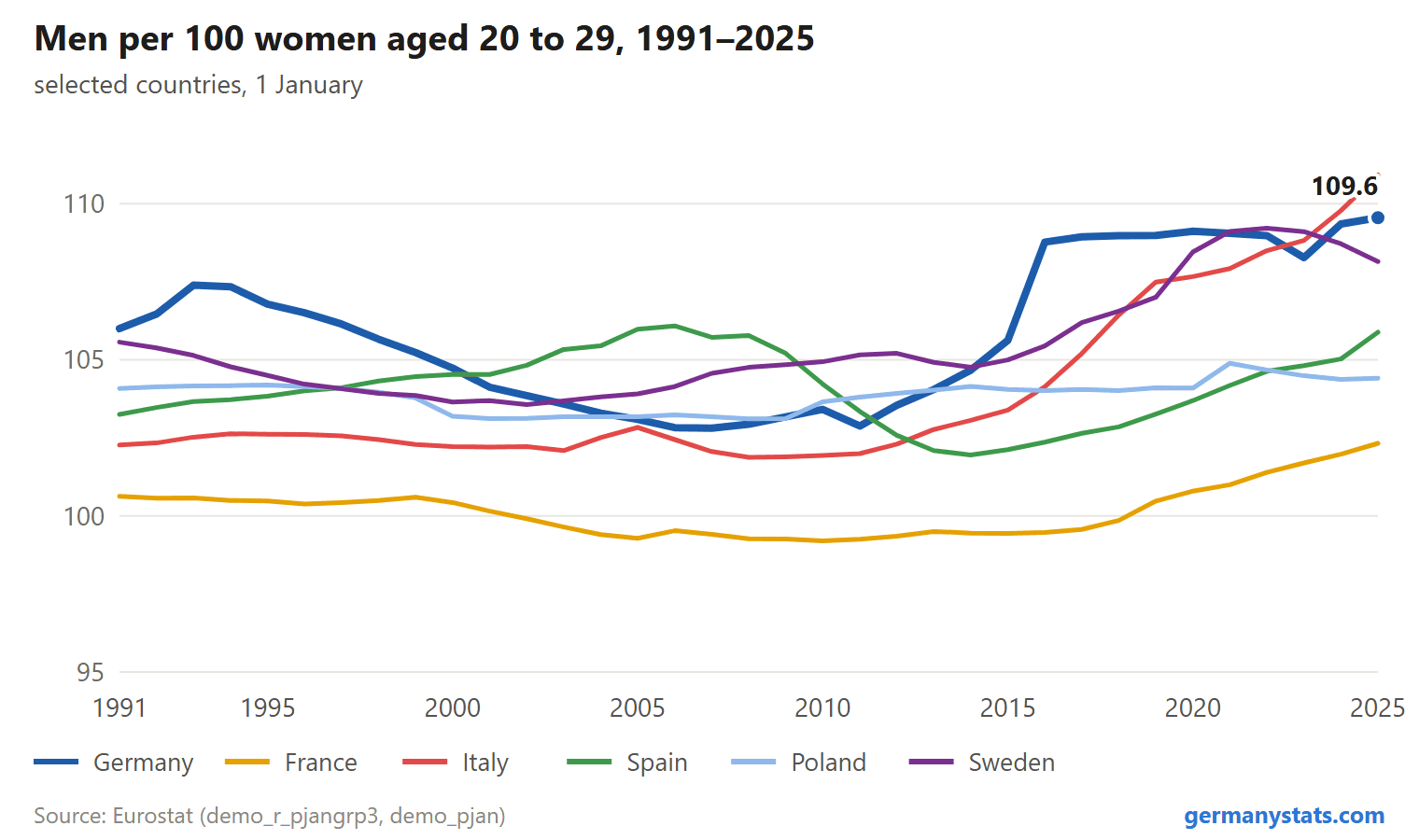
In most countries there have always been slightly more young men than women, because more boys are born. Since the mid-2010s the gap has widened in many places due to immigration, in which young men predominate. In Germany the ratio rose from 104.7 (2014) to 109.6 (2025), in Sweden from 104.8 to 108.1. In France it remained almost balanced (2025: 102.3).
More on Germany, with a map of all districts and the trend since 1967: Gender ratio in Germany.
Related: Gender ratio in Germany, Unemployment Rate in Europe, Birth rate in Germany and Foreigners in Germany.
Frequently asked questions
Where in Europe are there the most young men compared with women?
Among countries, Malta with 133.8 men per 100 women aged 20 to 29 (2025). Among regions, Greek islands and border regions such as Evros (249), where refugee reception centres are located.
Where in Europe do more young women than men live?
Among countries, in Albania and Moldova. Among regions, mainly in university cities such as Freiburg im Breisgau, Tiranë and Paris.
How does Germany compare?
Germany has an above-average male surplus with 109.6 men per 100 women aged 20 to 29 (EU-27: 106.9) and ranks 8 of 36 countries.
Why are there more young men than women?
About 105 boys are born for every 100 girls. In addition, young men usually predominate among immigrants. Regionally, study and work shift the ratio: young women more often move to university cities, while young men more often stay in rural areas or move to industrial locations.
How are the region boundaries on the map drawn?
For Germany we show the official district boundaries. For the other countries we draw the regions ourselves: each country is divided between the centres of its regions and cut along coastlines and national borders. The boundaries are therefore simplified; the figures are the official Eurostat values.