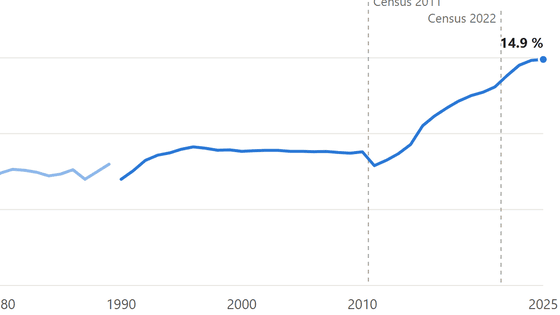
In short: On 31 December 2025, Germany had a population of 83,467,117 (about 83.5 million). That is 110,023 fewer than a year earlier. There were 1,006,588 deaths but only 654,241 births, and net immigration (+235,000) no longer made up for this deficit of 352,347. Germany is the most populous country in the European Union.
Population of Germany since 1950
West Germany grew from 51.0 million people in 1950 to 62.7 million in 1989. With reunification, the population of the former GDR was added: at the end of 1990, Germany had 79.8 million inhabitants. Since 1972 more people have died in Germany each year than have been born, so population growth depends entirely on immigration – particularly strong in 2015 and 2022. The dips in 2011 and 2022 are caused by the censuses, which each found around 1.4 to 1.5 million fewer residents than previously estimated.
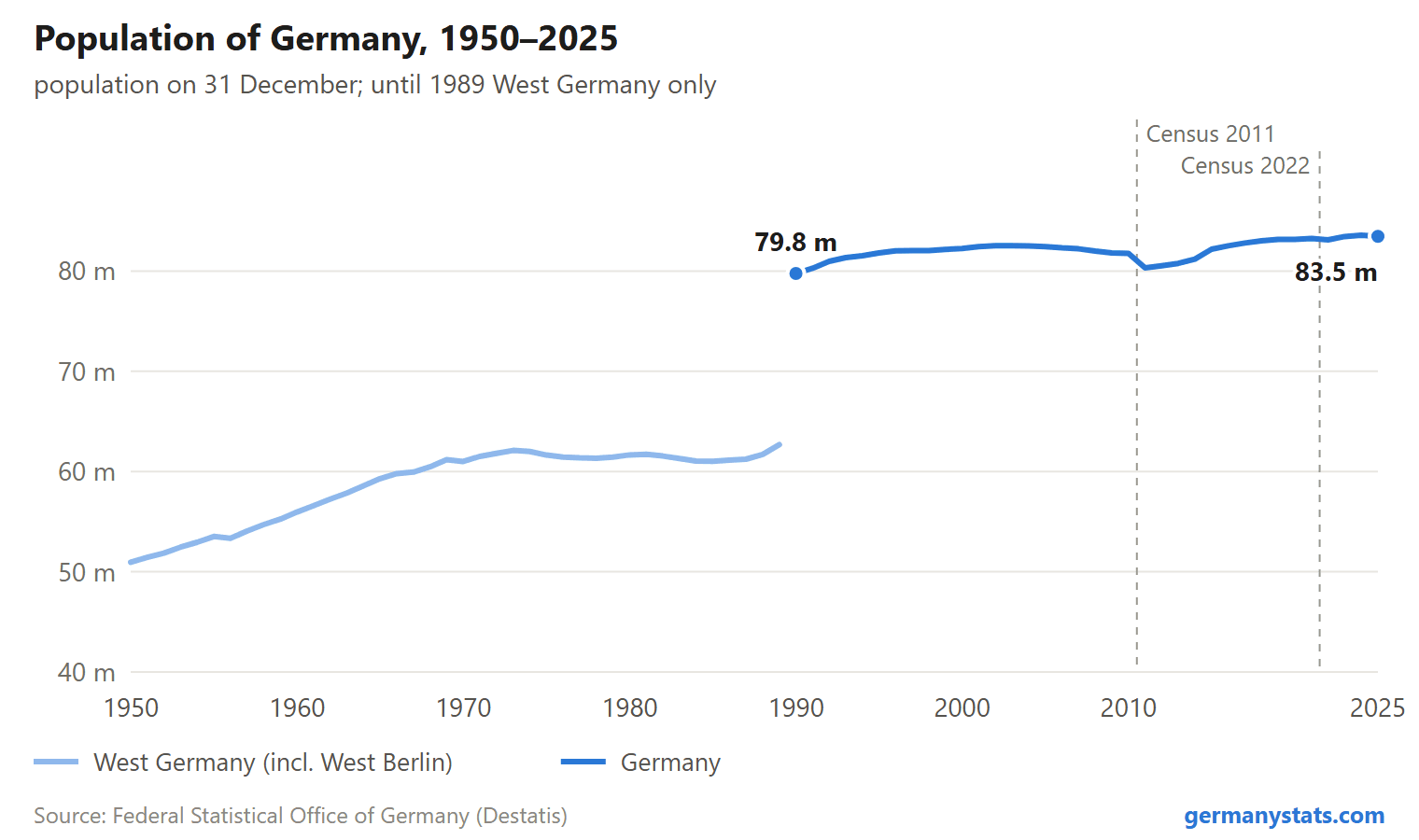
| Year | Population | Territory |
|---|---|---|
| 1950 | 50,958,125 | West Germany |
| 1970 | 61,001,164 | West Germany |
| 1989 | 62,679,035 | West Germany |
| 1990 | 79,753,227 | Germany |
| 2000 | 82,259,540 | Germany |
| 2010 | 81,751,602 | Germany |
| 2020 | 83,155,031 | Germany |
| 2024 | 83,577,140 | Germany |
| 2025 | 83,467,117 | Germany |
Why is the population falling in 2025?
Whether the population grows depends on two balances: births minus deaths, and people moving in minus people moving out. Since 1972 more people have died in Germany each year than have been born. In 2025 there were 1,006,588 deaths and 654,241 births – a deficit of 352,347. At the same time, 235,000 more people moved to Germany than left. In 2022, the year people fled the war in Ukraine, net immigration was still 1,462,089, and in 2024 430,183. Because immigration has fallen sharply, it is no longer enough to offset the birth deficit, so the population is shrinking. The sum of the two balances differs slightly from the actual change because the population figures also include later corrections of the population registers.
| Year | Births | Deaths | Births minus deaths | Net migration | Population change |
|---|---|---|---|---|---|
| 2019 | 778,090 | 939,520 | −161,430 | +327,060 | +147,498 |
| 2020 | 773,144 | 985,572 | −212,428 | +220,251 | −11,680 |
| 2021 | 795,492 | 1,023,687 | −228,195 | +329,163 | +82,093 |
| 2022 | 738,819 | 1,066,341 | −327,522 | +1,462,089 | −118,623 * |
| 2023 | 692,989 | 1,028,206 | −335,217 | +662,964 | +337,544 |
| 2024 | 677,117 | 1,007,758 | −330,641 | +430,183 | +121,095 |
| 2025 | 654,241 | 1,006,588 | −352,347 | +235,000 | −110,023 |
* Change affected by the census (population recalculated).
Population of the German federal states
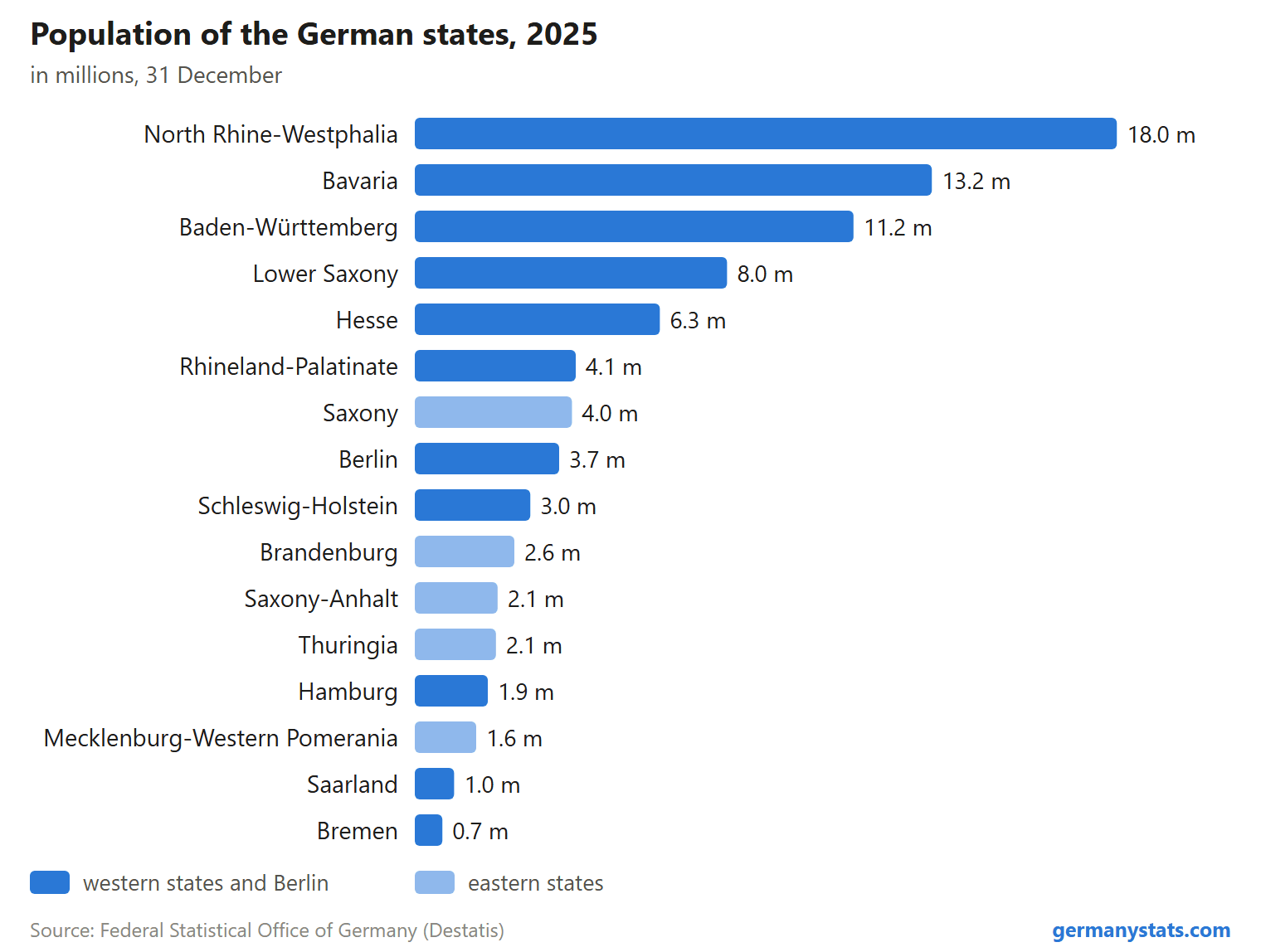
North Rhine-Westphalia is the most populous state with 18.0 million inhabitants, followed by Bavaria (13.2 million) and Baden-Württemberg (11.2 million). The smallest is Bremen. Since 1990, Bavaria has grown the most (+15.7 %), while Saxony-Anhalt has lost 26 % of its population.
| State | Population 2025 | Population 1990 | Change |
|---|---|---|---|
| North Rhine-Westphalia | 17,986,214 | 17,349,651 | +3.7 % |
| Bavaria | 13,245,503 | 11,448,823 | +15.7 % |
| Baden-Württemberg | 11,238,761 | 9,822,027 | +14.4 % |
| Lower Saxony | 8,000,826 | 7,387,245 | +8.3 % |
| Hesse | 6,278,594 | 5,763,310 | +8.9 % |
| Rhineland-Palatinate | 4,123,022 | 3,763,510 | +9.6 % |
| Saxony | 4,026,599 | 4,764,301 | −15.5 % |
| Berlin | 3,700,577 | 3,433,695 | +7.8 % |
| Schleswig-Holstein | 2,958,519 | 2,626,127 | +12.7 % |
| Brandenburg | 2,551,889 | 2,578,312 | −1.0 % |
| Saxony-Anhalt | 2,120,252 | 2,873,957 | −26.2 % |
| Thuringia | 2,078,946 | 2,611,319 | −20.4 % |
| Hamburg | 1,869,473 | 1,652,363 | +13.1 % |
| Mecklenburg-Western Pomerania | 1,573,685 | 1,923,959 | −18.2 % |
| Saarland | 1,007,342 | 1,072,963 | −6.1 % |
| Bremen | 706,915 | 681,665 | +3.7 % |
Population density by district
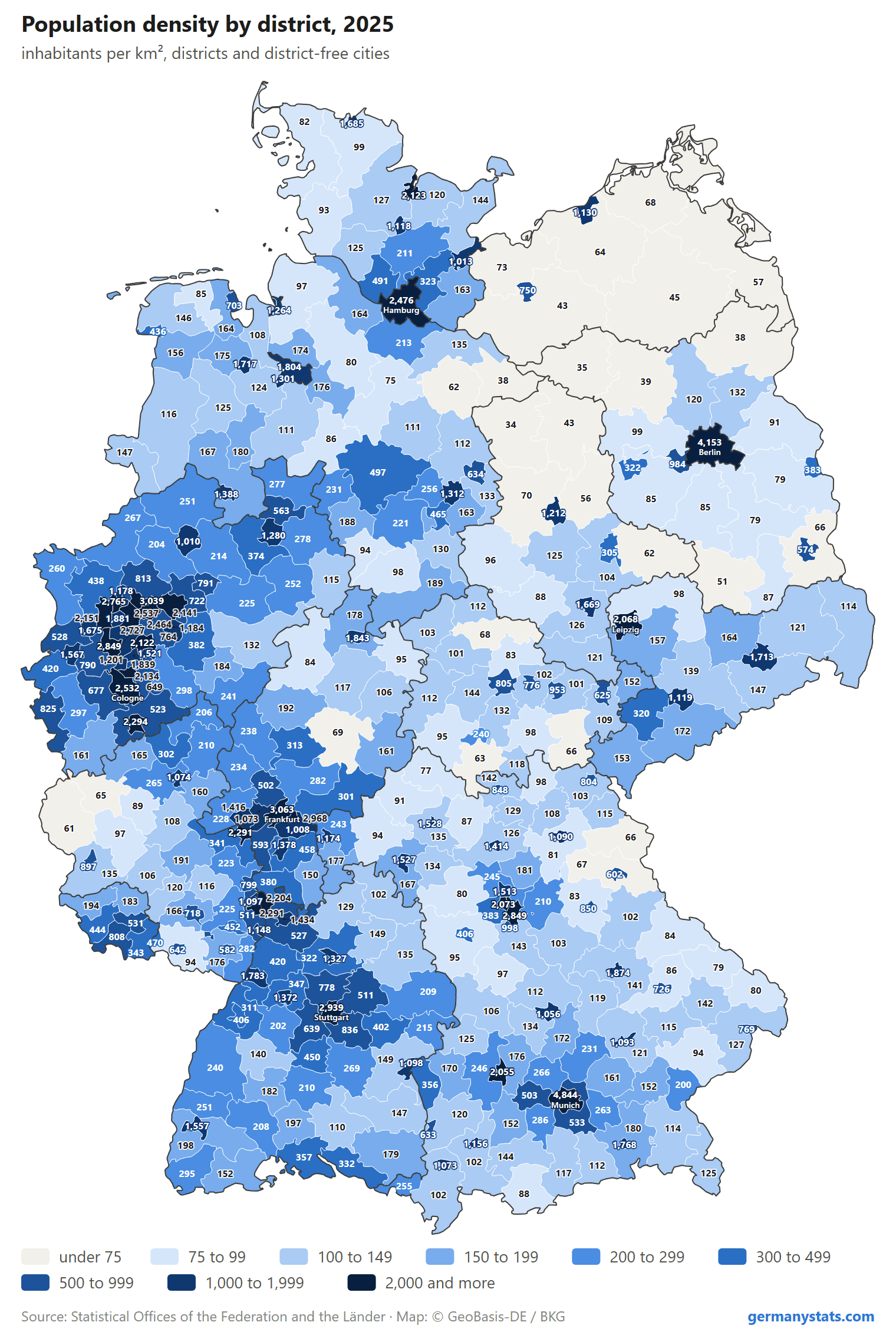
On average, 233 people live on one square kilometre in Germany. The most densely populated district is Munich with 4,844 inhabitants per km², followed by Berlin (4,153). The emptiest areas are rural districts in the north-east with fewer than 40 inhabitants per km².
Largest cities in Germany
The largest city is Berlin with 3,700,577 inhabitants, ahead of Hamburg and Munich. The list includes district-free cities; cities that belong to a district or region, such as Hanover or Aachen, are not listed separately.
| Rank | City | Population 2025 | per km² |
|---|---|---|---|
| 1 | Berlin | 3,700,577 | 4,153 |
| 2 | Hamburg | 1,869,473 | 2,476 |
| 3 | Munich | 1,505,036 | 4,844 |
| 4 | Cologne | 1,025,523 | 2,532 |
| 5 | Frankfurt (Main) | 760,656 | 3,063 |
| 6 | Düsseldorf | 619,444 | 2,849 |
| 7 | Leipzig | 615,932 | 2,068 |
| 8 | Stuttgart | 609,365 | 2,939 |
| 9 | Dortmund | 600,880 | 2,141 |
| 10 | Bremen | 588,413 | 1,804 |
| 11 | Essen | 573,618 | 2,727 |
| 12 | Dresden | 562,764 | 1,713 |
| 13 | Nuremberg | 531,159 | 2,849 |
| 14 | Duisburg | 500,810 | 2,151 |
| 15 | Bochum | 358,880 | 2,464 |
Related: Average age in Germany, Birth rate in Germany, Foreigners in Germany and Emigration from Germany.
Frequently asked questions
What is the population of Germany?
On 31 December 2025, 83,467,117 people lived in Germany, around 83.5 million.
Is the population of Germany growing?
Only through immigration. Since 1972, deaths have exceeded births every year. In 2025, the population fell by 110,023: 1,006,588 deaths and 654,241 births, with net immigration of 235,000.
Which German state has the largest population?
North Rhine-Westphalia, with 17,986,214 inhabitants in 2025.
What is the population density of Germany?
About 233 inhabitants per square kilometre.