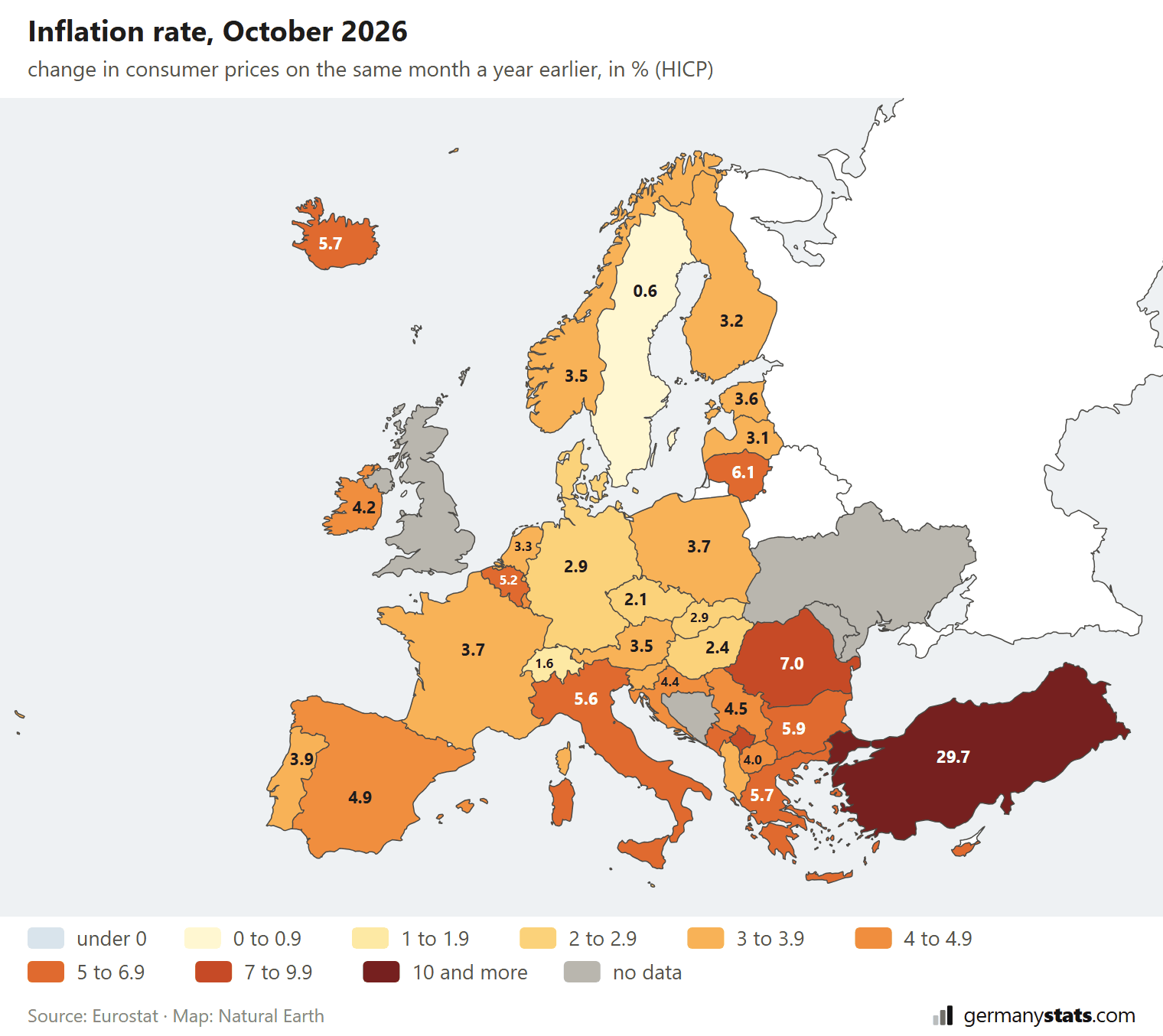
In short: EU inflation was 4.0% in October 2026, and 2.9% in Germany. The main driver is energy prices, which were about a fifth higher than a year earlier in the euro area. Inflation is highest in Türkiye (29.7%), Kosovo (7.1%) and Romania (7.0%) and lowest in Sweden (0.6%), Switzerland (1.6%) and Denmark (2.1%). The 2025 annual average for the EU was 2.5%.
Map: inflation rate in Europe, October 2026
Inflation has risen markedly again: in 28 of 36 countries it was 3% or more in October 2026. Türkiye, at 29.7%, is a special case: the lira lost much of its value over several years and the central bank kept interest rates low for a long time; in 2022 inflation there was above 80% at times. Inflation is very low in Switzerland (1.6%), where the strong franc makes imports cheaper.
More on Germany with product groups and the national consumer price index: inflation rate in Germany.
Inflation in Europe: countries compared
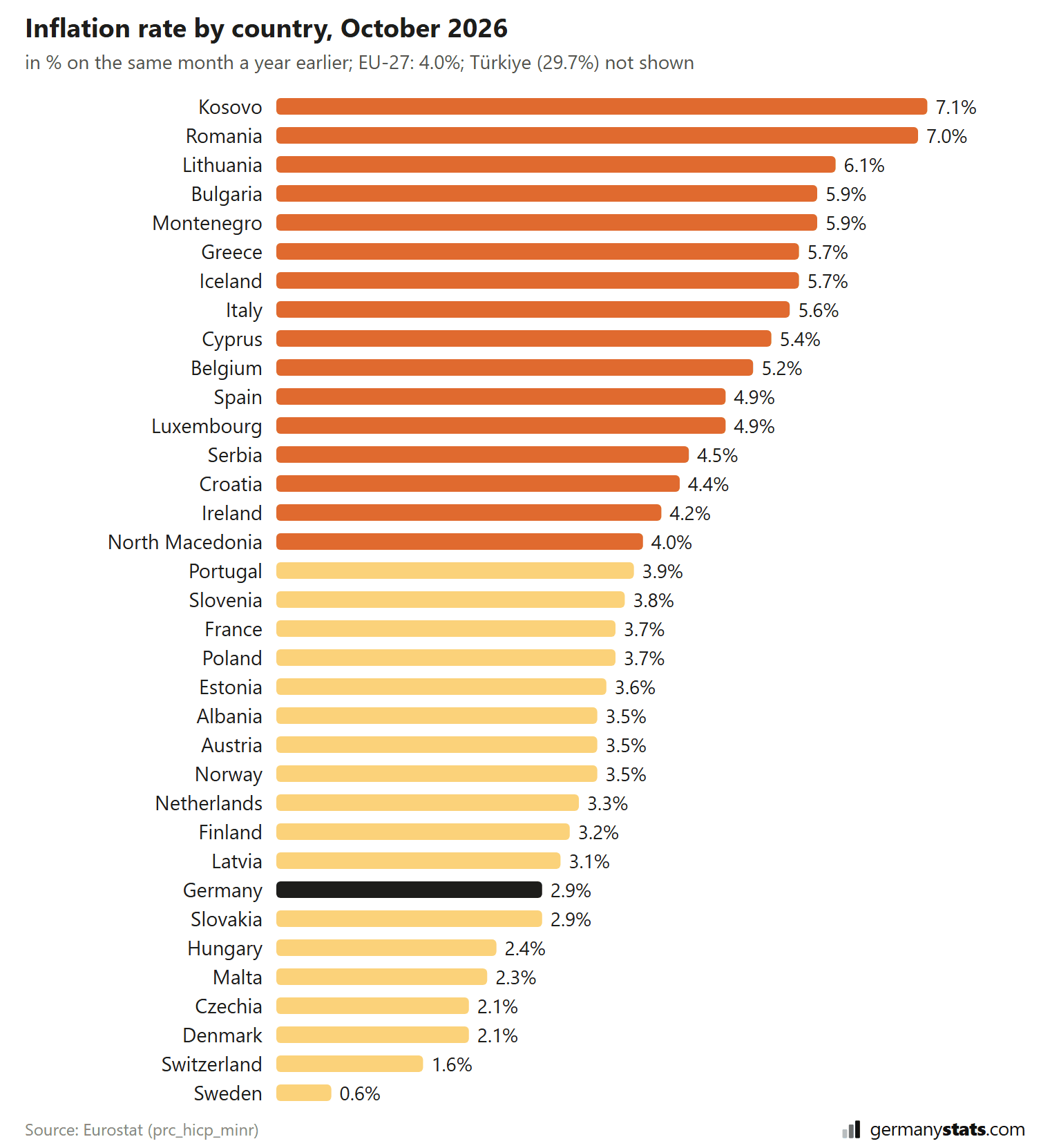
Excluding Türkiye, the range in October 2026 is from 0.6% (Sweden) to 7.1% (Kosovo). In 2025, Romania had the highest annual rate in the EU at 6.8%: electricity price caps expired there in 2025 and VAT was raised. Germany's rate was 2.3% in 2025 (harmonised index; the national consumer price index differs slightly).
| Country | Oct 2026 | 2025 | 2024 | 2023 | 2022 | 2021 |
|---|---|---|---|---|---|---|
| Türkiye | 29.7% | 34.9% | 58.5% | 54.0% | 72.3% | 19.6% |
| Kosovo | 7.1% | 3.9% | 1.6% | 4.9% | 11.6% | 3.4% |
| Romania | 7.0% | 6.8% | 5.8% | 9.7% | 12.0% | 4.1% |
| Lithuania | 6.1% | 3.4% | 0.9% | 8.7% | 18.9% | 4.6% |
| Bulgaria | 5.9% | 3.5% | 2.6% | 8.6% | 13.0% | 2.8% |
| Montenegro | 5.9% | 4.1% | 3.6% | 8.7% | 11.9% | 2.5% |
| Greece | 5.7% | 2.9% | 3.0% | 4.2% | 9.3% | 0.6% |
| Iceland | 5.7% | 3.7% | 4.5% | 8.0% | 5.7% | 3.7% |
| Italy | 5.6% | 1.6% | 1.1% | 5.9% | 8.7% | 2.0% |
| Cyprus | 5.4% | 0.8% | 2.3% | 3.9% | 8.1% | 2.3% |
| Belgium | 5.2% | 3.0% | 4.3% | 2.3% | 10.3% | 3.2% |
| Spain | 4.9% | 2.7% | 2.9% | 3.4% | 8.3% | 3.0% |
| Luxembourg | 4.9% | 2.5% | 2.3% | 2.9% | 8.2% | 3.5% |
| Serbia | 4.5% | 4.1% | 4.8% | 12.1% | 11.7% | 4.0% |
| Croatia | 4.4% | 4.4% | 4.0% | 8.4% | 10.7% | 2.7% |
| Ireland | 4.2% | 2.1% | 1.3% | 5.2% | 8.1% | 2.4% |
| North Macedonia | 4.0% | 4.3% | 4.2% | 9.0% | 14.0% | 3.4% |
| Portugal | 3.9% | 2.2% | 2.7% | 5.3% | 8.1% | 0.9% |
| Slovenia | 3.8% | 2.5% | 2.0% | 7.2% | 9.3% | 2.0% |
| France | 3.7% | 0.9% | 2.3% | 5.7% | 5.9% | 2.1% |
| Poland | 3.7% | 3.3% | 3.7% | 10.8% | 13.2% | 5.2% |
| Estonia | 3.6% | 4.8% | 3.7% | 9.1% | 19.4% | 4.5% |
| Albania | 3.5% | 2.3% | 2.6% | 5.3% | 6.6% | 2.3% |
| Austria | 3.5% | 3.6% | 2.9% | 7.7% | 8.6% | 2.8% |
| Norway | 3.5% | 2.8% | 2.8% | 5.7% | 6.2% | 3.9% |
| Netherlands | 3.3% | 3.0% | 3.2% | 4.1% | 11.6% | 2.8% |
| Finland | 3.2% | 1.8% | 1.0% | 4.3% | 7.2% | 2.1% |
| Latvia | 3.1% | 3.8% | 1.3% | 9.1% | 17.2% | 3.2% |
| Germany | 2.9% | 2.3% | 2.5% | 6.0% | 8.7% | 3.2% |
| Slovakia | 2.9% | 4.2% | 3.2% | 11.0% | 12.1% | 2.8% |
| Hungary | 2.4% | 4.4% | 3.7% | 17.0% | 15.3% | 5.2% |
| Malta | 2.3% | 2.4% | 2.4% | 5.6% | 6.1% | 0.7% |
| Czechia | 2.1% | 2.3% | 2.7% | 12.0% | 14.8% | 3.3% |
| Denmark | 2.1% | 1.8% | 1.3% | 3.4% | 8.6% | 1.9% |
| Switzerland | 1.6% | 0.1% | 1.1% | 2.3% | 2.7% | 0.5% |
| Sweden | 0.6% | 2.6% | 2.0% | 5.9% | 8.1% | 2.7% |
| EU-27 | 4.0% | 2.5% | 2.6% | 6.4% | 9.2% | 2.9% |
Inflation since 2000
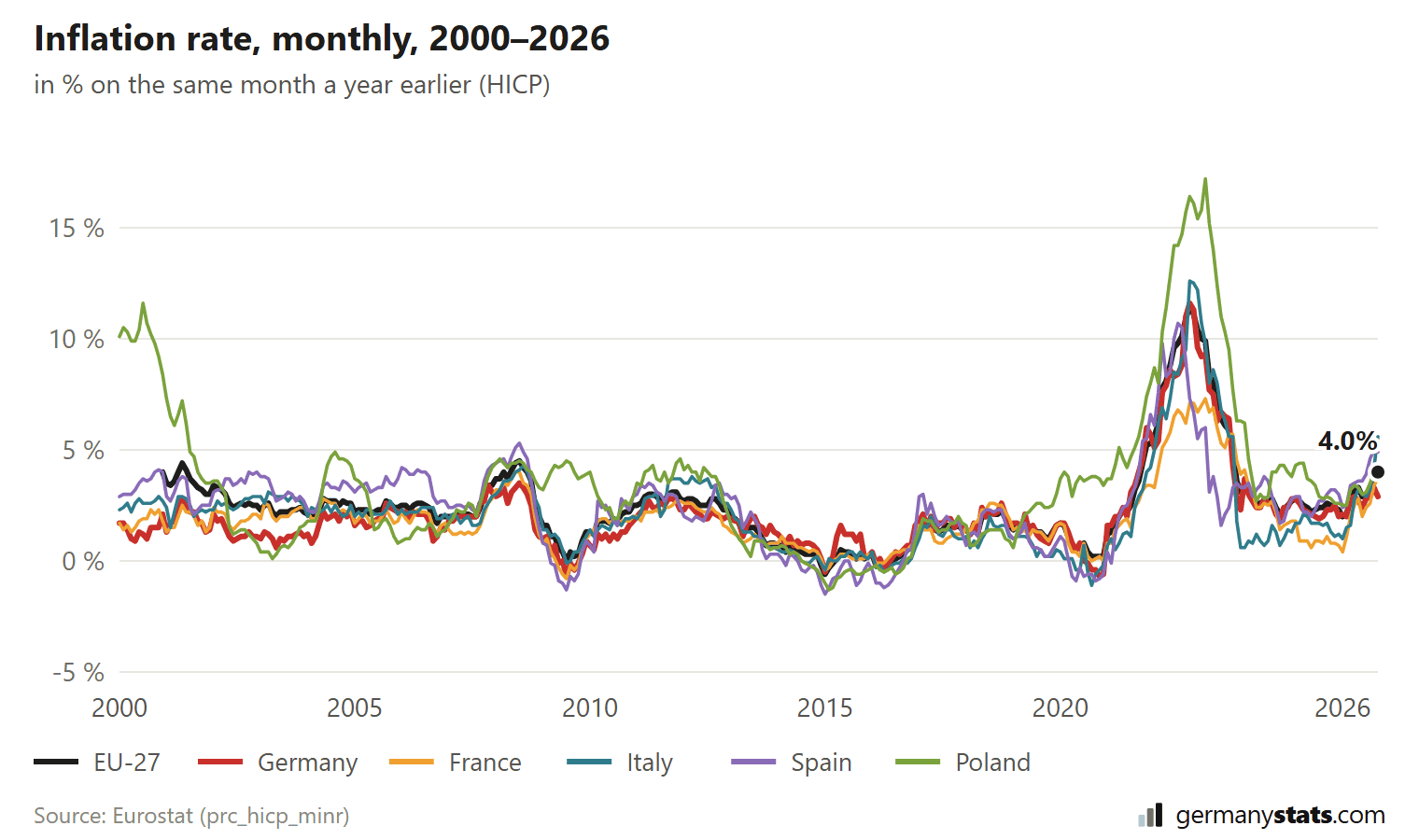
Until 2021, EU inflation was mostly around 2%, with spikes in 2008 (oil prices) and 2011. In the years after the euro crisis it was even close to zero at times. From mid-2021 prices rose sharply: supply chains were disrupted after the COVID-19 crisis, and after Russia's invasion of Ukraine in February 2022 energy prices soared. EU inflation peaked at 11.5% in October 2022, Germany at 11.6% in October 2022 and Estonia at 25.2% in August 2022. The European Central Bank raised interest rates rapidly from July 2022; by 2025 inflation had fallen to 2.5%. It picked up again in 2026, mainly because of sharply rising energy prices (October 2026: 4.0%).
Related: Inflation rate in Germany, GDP per Capita in Europe and Unemployment Rate in Europe.
Frequently asked questions
What is the inflation rate in Europe?
EU inflation was 4.0% in October 2026; in the euro area it was 4.0%. The annual average for 2025 was 2.5%.
Which European country has the highest inflation?
Türkiye (29.7% in October 2026). Within the EU: Romania (7.0%) and Lithuania (6.1%).
When was inflation in Europe highest?
In autumn 2022: 11.5% in the EU (October 2022), driven by energy prices after Russia's invasion of Ukraine.
Why does the German figure differ from the national inflation rate?
Eurostat uses the Harmonised Index of Consumer Prices (HICP), which is comparable across countries. The German national consumer price index also includes owner-occupied housing costs and weights some goods differently.