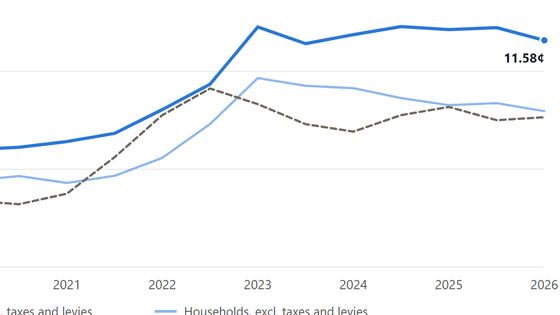
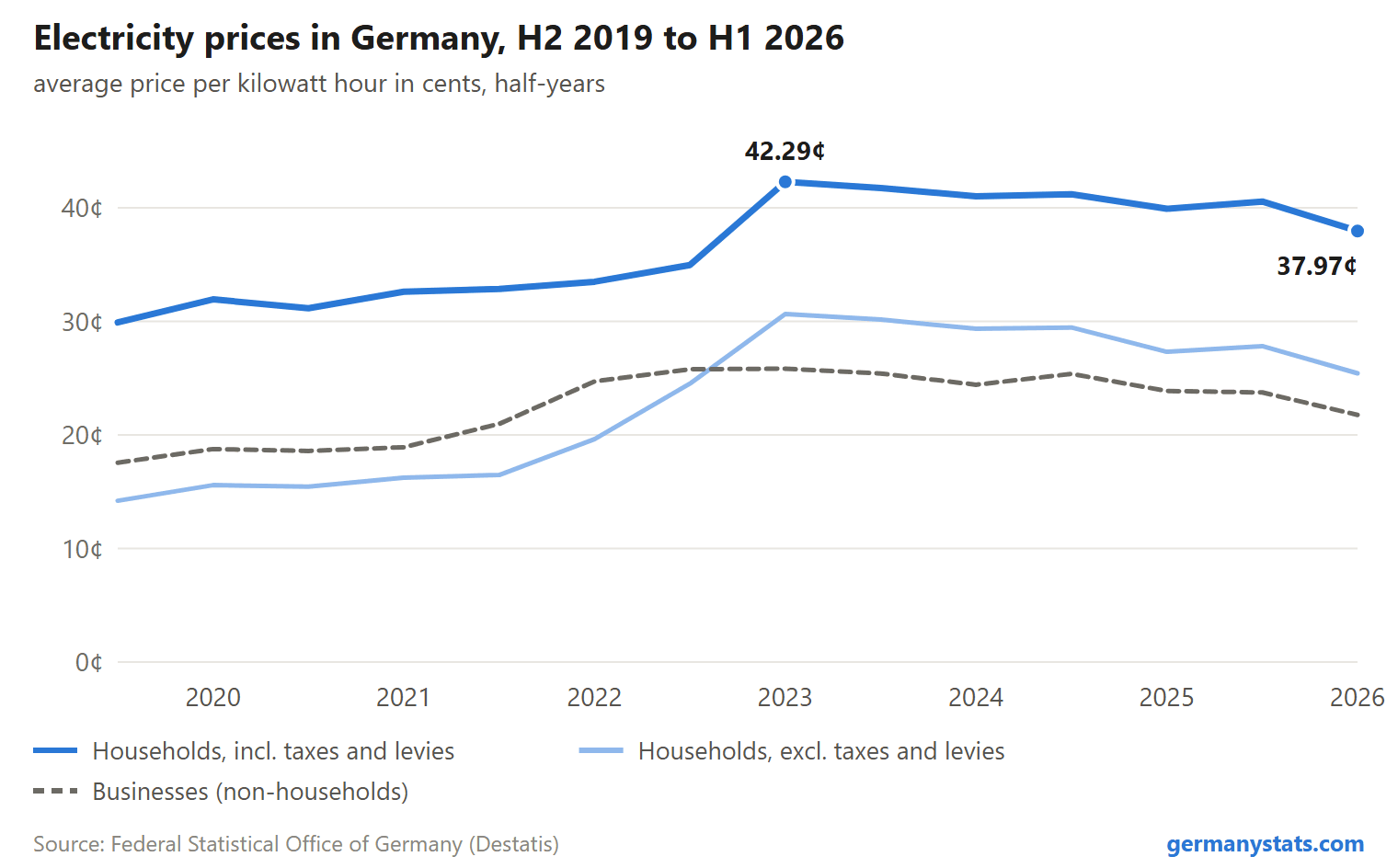
In short: In the first half of 2026, private households in Germany paid an average of 37.97 cents per kilowatt hour of electricity, including all taxes, levies and surcharges (a year earlier: 39.92 cents). For a typical household using 2,500 to 5,000 kWh a year it was 36.18 cents. Electricity was most expensive in the first half of 2023 at 42.29 cents. Since 1991, electricity prices have risen by 188 %, consumer prices overall by 97 %.
Household electricity prices since 2019
Until 2021, the average household electricity price was between 30 and 33 cents per kilowatt hour. In the energy crisis after Russia's invasion of Ukraine, wholesale costs soared and the price reached 42.29 cents in the first half of 2023. It has fallen since, but at 37.97 cents it is still 27 % higher than in the second half of 2019 (29.92 cents). Businesses and other non-household customers pay much less (21.76 cents) because they buy more electricity and many of them benefit from tax and levy relief.
| Half-year | Households | excl. taxes and levies | Businesses |
|---|---|---|---|
| H1 2026 | 37.97 cents | 25.43 cents | 21.76 cents |
| H2 2025 | 40.55 cents | 27.82 cents | 23.74 cents |
| H1 2025 | 39.92 cents | 27.33 cents | 23.87 cents |
| H2 2024 | 41.20 cents | 29.46 cents | 25.38 cents |
| H1 2024 | 41.02 cents | 29.35 cents | 24.43 cents |
| H2 2023 | 41.75 cents | 30.16 cents | 25.41 cents |
| H1 2023 | 42.29 cents | 30.66 cents | 25.84 cents |
| H2 2022 | 34.96 cents | 24.52 cents | 25.79 cents |
| H1 2022 | 33.50 cents | 19.63 cents | 24.72 cents |
| H2 2021 | 32.87 cents | 16.47 cents | 20.97 cents |
| H1 2021 | 32.62 cents | 16.23 cents | 18.91 cents |
| H2 2020 | 31.16 cents | 15.45 cents | 18.60 cents |
| H1 2020 | 31.94 cents | 15.58 cents | 18.75 cents |
| H2 2019 | 29.92 cents | 14.21 cents | 17.56 cents |
What makes up the electricity price?
The price has three parts: energy procurement and supply, network charges for transmission and distribution, and taxes, levies and surcharges (electricity tax, VAT, concession fees and other surcharges). In 2019, taxes and levies still made up 53 % of the price. The renewable energy surcharge (EEG levy) was abolished in July 2022; in 2025 the share was 31 %. At the same time, energy and supply costs rose from 6.17 cents (2019) to 15.46 cents (2025) and network costs from 8.04 cents to 12.11 cents.
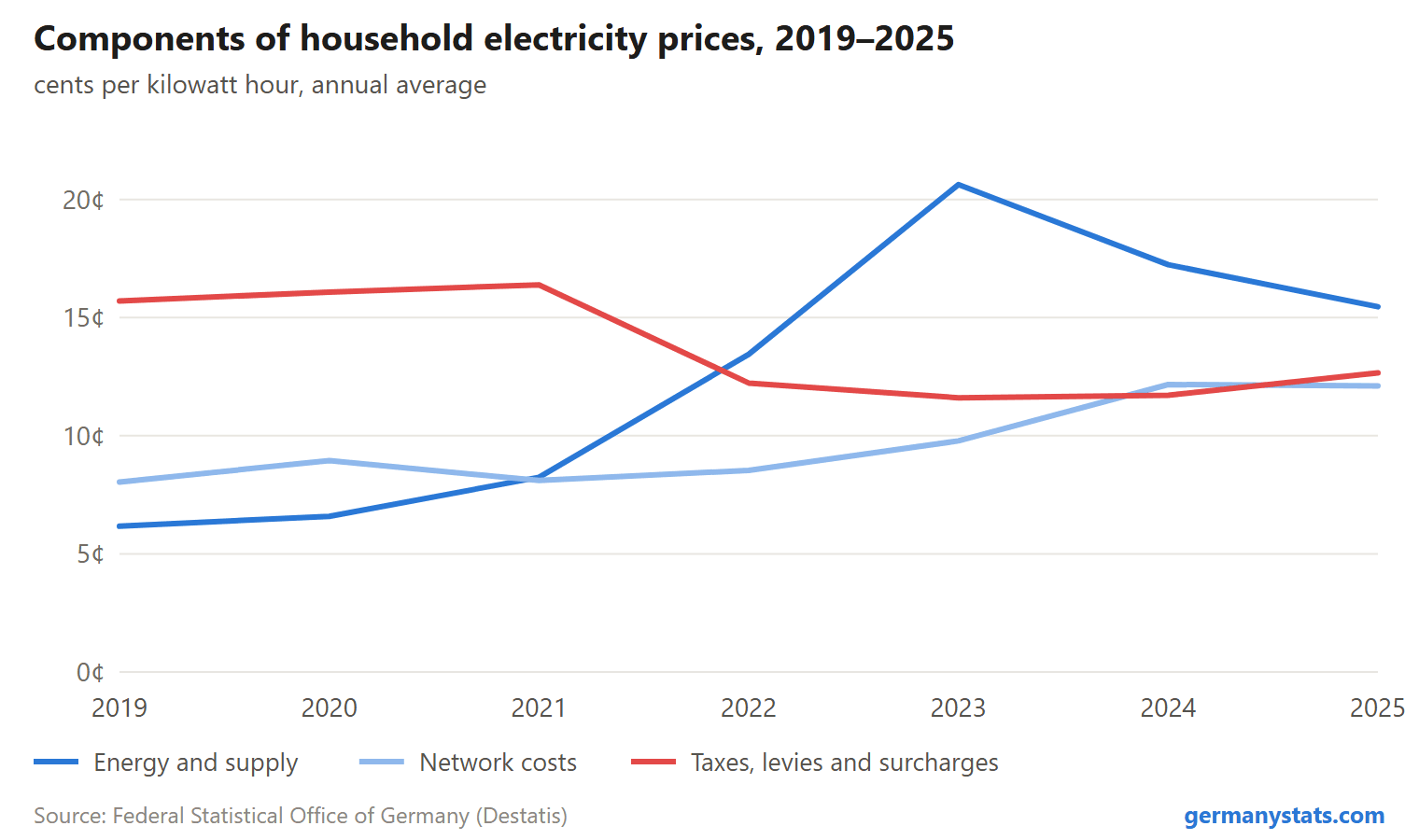
| Year | Energy and supply | Network costs | Taxes, levies | Price |
|---|---|---|---|---|
| 2019 | 6.17 cents | 8.04 cents | 15.71 cents | 29.92 cents |
| 2020 | 6.59 cents | 8.94 cents | 16.08 cents | 31.61 cents |
| 2021 | 8.24 cents | 8.11 cents | 16.39 cents | 32.74 cents |
| 2022 | 13.45 cents | 8.53 cents | 12.23 cents | 34.21 cents |
| 2023 | 20.63 cents | 9.78 cents | 11.61 cents | 42.02 cents |
| 2024 | 17.24 cents | 12.17 cents | 11.72 cents | 41.13 cents |
| 2025 | 15.46 cents | 12.11 cents | 12.66 cents | 40.23 cents |
Annual electricity bills: what does a household pay?
The less electricity a household uses, the higher the price per kilowatt hour, because the fixed standing charge is spread over fewer units. Households using less than 1,000 kWh paid an average of 57.99 cents in the first half of 2026, households using 5,000 to 14,999 kWh only 32.14 cents. Based on the average prices for each consumption band, typical annual bills are:
| Household (example) | Annual use | Price per kWh | Annual bill | per month |
|---|---|---|---|---|
| 1 person | 1,500 kWh | 41.65 cents | €625 | €52 |
| 2 people | 2,500 kWh | 36.18 cents | €905 | €75 |
| 3 people | 3,500 kWh | 36.18 cents | €1,266 | €106 |
| 4 people | 4,250 kWh | 36.18 cents | €1,538 | €128 |
| Consumption band | Price H1 2026 |
|---|---|
| under 1,000 kWh | 57.99 cents |
| 1,000 to 2,499 kWh | 41.65 cents |
| 2,500 to 4,999 kWh | 36.18 cents |
| 5,000 to 14,999 kWh | 32.14 cents |
| 15,000 kWh and more | 30.55 cents |
The consumption figures are examples; actual use depends heavily on electric water heating, heat pumps or electric cars. New contracts and default supply tariffs can differ considerably from the average.
Electricity prices since 1991 compared with inflation
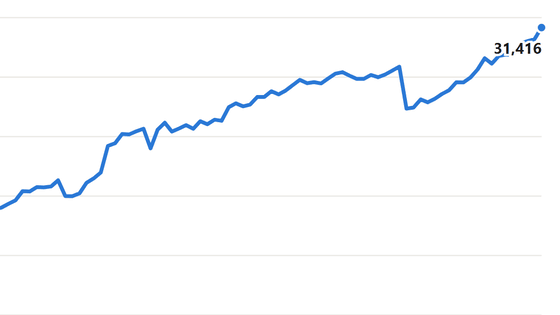
There are no official average prices in cents before 2019, but there is a consumer price index for electricity. According to it, electricity prices have risen by 188 % since 1991, much faster than consumer prices overall (+97 %). During the 1990s electricity prices were almost stable (2000: +4 % compared with 1991). After that they rose almost every year, partly due to the electricity tax and the EEG levy for renewable energy; the biggest jump came in the energy crisis in 2022 (+19.2 %).
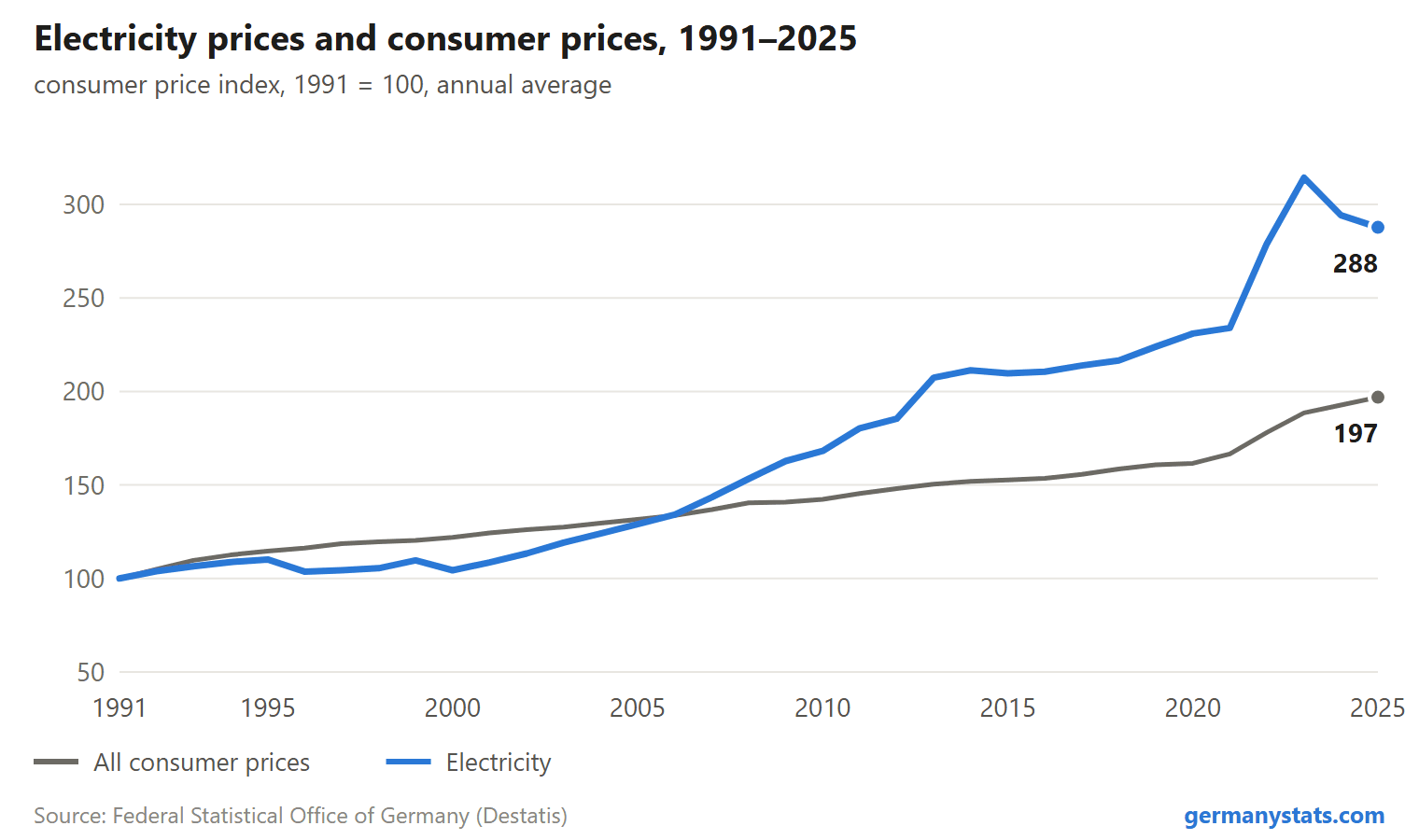
| Year | Electricity (1991 = 100) | Change on previous year | Consumer prices (1991 = 100) |
|---|---|---|---|
| 1991 | 100 | – | 100 |
| 1995 | 110 | +1.3 % | 115 |
| 2000 | 104 | −4.8 % | 122 |
| 2005 | 129 | +4.1 % | 132 |
| 2010 | 168 | +3.3 % | 142 |
| 2015 | 210 | −0.8 % | 153 |
| 2020 | 231 | +3.1 % | 162 |
| 2022 | 279 | +19.2 % | 178 |
| 2023 | 314 | +12.7 % | 189 |
| 2025 | 288 | −2.2 % | 197 |
Related: Gas prices in Germany, Inflation rate in Germany, Wind turbines in Germany and Solar power in Germany.
Frequently asked questions
What is the current electricity price in Germany?
In the first half of 2026, private households paid an average of 37.97 cents per kilowatt hour, including all taxes, levies and surcharges. Households using 2,500 to 4,999 kWh a year paid 36.18 cents.
How much does 1 kWh of electricity cost in Germany?
On average 37.97 cents (H1 2026). Depending on consumption, the range is from 30.55 cents for very high use to 57.99 cents for less than 1,000 kWh a year.
How much is the electricity bill for 2 people?
At 2,500 kWh a year and 36.18 cents per kWh, about €905 a year or €75 a month (estimate based on official average prices).
When was electricity most expensive in Germany?
In the first half of 2023, at an average of 42.29 cents per kilowatt hour – at the height of the energy crisis.
Why is electricity so expensive in Germany?
In 2025, 38 % of the price went on energy and supply, 30 % on network costs and 31 % on taxes, levies and surcharges.
Are there electricity prices by German state?
Official statistics only publish electricity prices for Germany as a whole. Regional differences come mainly from network charges, which are higher in many rural areas in the north and east.