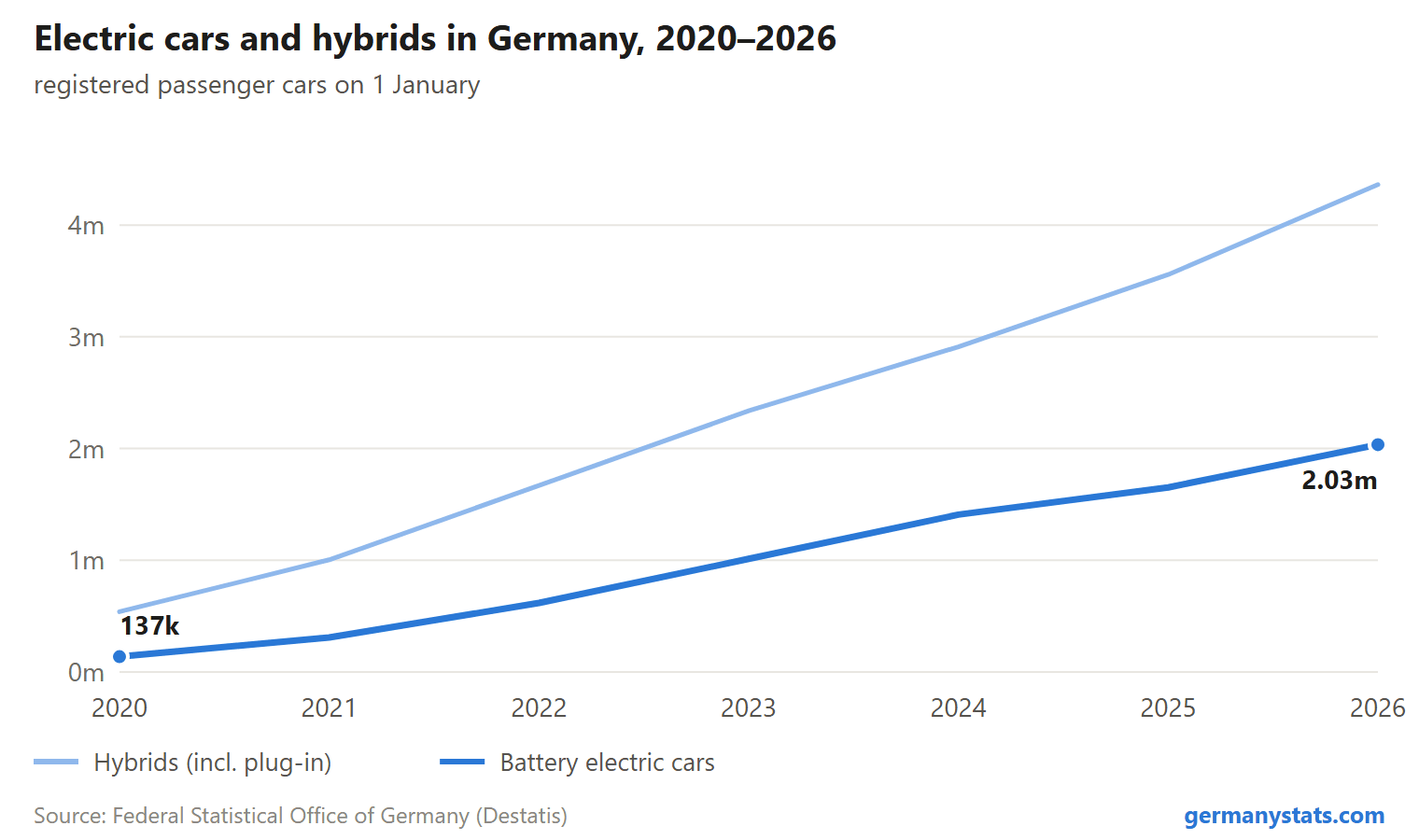
In short: On 1 January 2026, 2.03 million battery electric cars were registered in Germany, 382,617 more than a year earlier. That is 4.1 % of all 49.5 million passenger cars, up from 136,617 (0.3 %) in 2020. There were also 4.36 million hybrids, 1.12 million of them plug-in hybrids. Hamburg has the highest share (5.3 %); in the eastern states it is only 2.3 %.
Electric cars in Germany since 2020
The number of battery electric cars has grown 15-fold since 2020, from 136,617 to 2.03 million. Their share of the car fleet is still small because only a small part of Germany's roughly 49 million cars is replaced each year. The government purchase subsidy (Umweltbonus) ended in December 2023; in the following year the fleet grew by only 242,962 cars, compared with 395,672 the year before. In 2025, 382,617 were added again.
| 1 January | Electric cars | Share | Hybrids | of which plug-in | All cars |
|---|---|---|---|---|---|
| 2020 | 136,617 | 0.3 % | 539,383 | 102,175 | 47,715,977 |
| 2021 | 309,083 | 0.6 % | 1,004,089 | 279,861 | 48,248,584 |
| 2022 | 618,460 | 1.3 % | 1,669,051 | 565,956 | 48,540,878 |
| 2023 | 1,013,009 | 2.1 % | 2,337,897 | 864,712 | 48,763,036 |
| 2024 | 1,408,681 | 2.9 % | 2,911,262 | 921,886 | 49,098,685 |
| 2025 | 1,651,643 | 3.3 % | 3,556,956 | 967,423 | 49,339,166 |
| 2026 | 2,034,260 | 4.1 % | 4,362,563 | 1,122,958 | 49,486,487 |
Petrol, diesel and other fuels since 2001
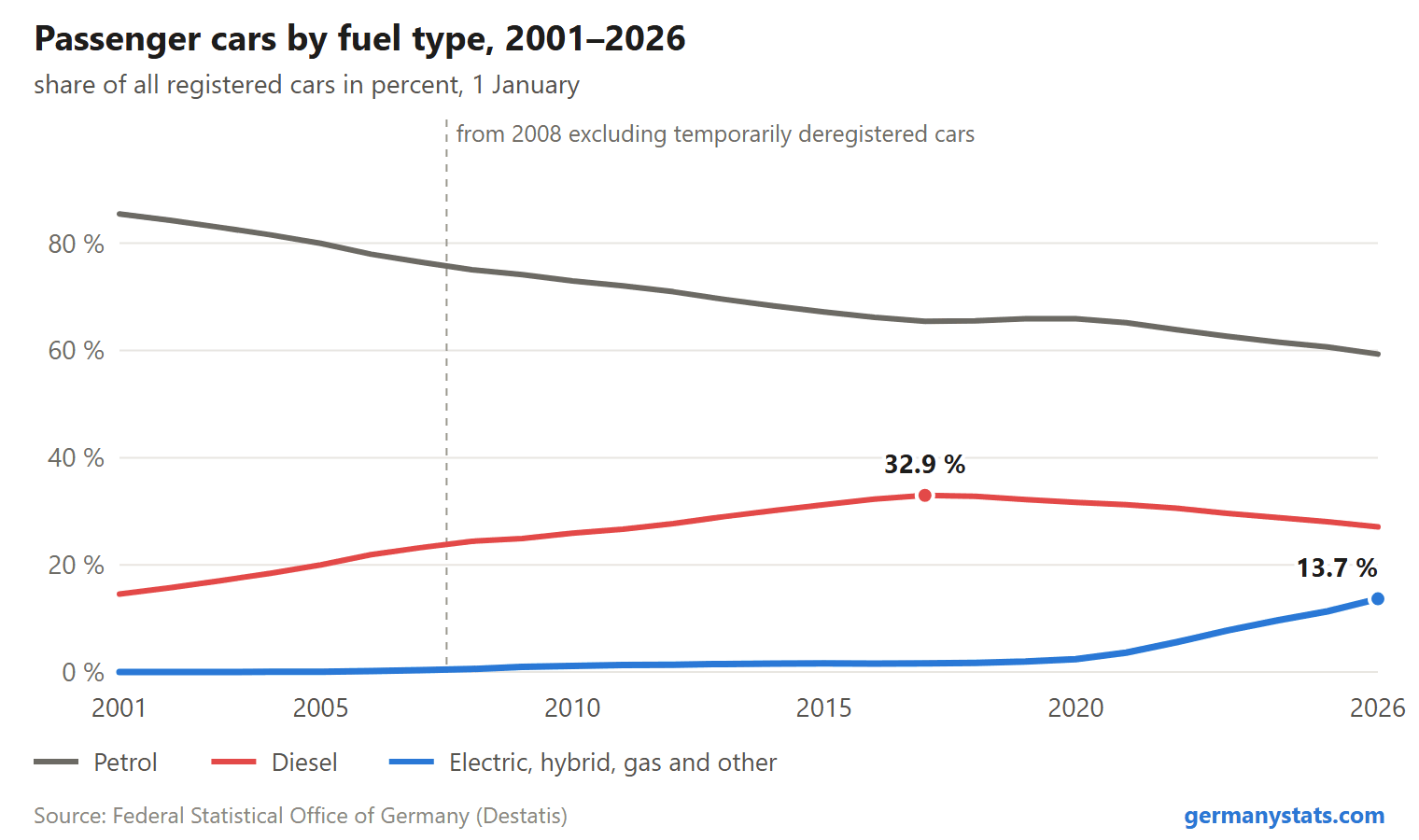
For a long time almost all cars in Germany ran on petrol or diesel. The diesel share rose to 32.9 % in 2017 and has been falling since the emissions scandal and city driving bans; in 2026 it was 27.0 %. The share of petrol-only cars has also fallen, from 85.5 % in 2001 to 59.3 %. Electric cars, hybrids and gas-powered cars together now account for 13.7 %.
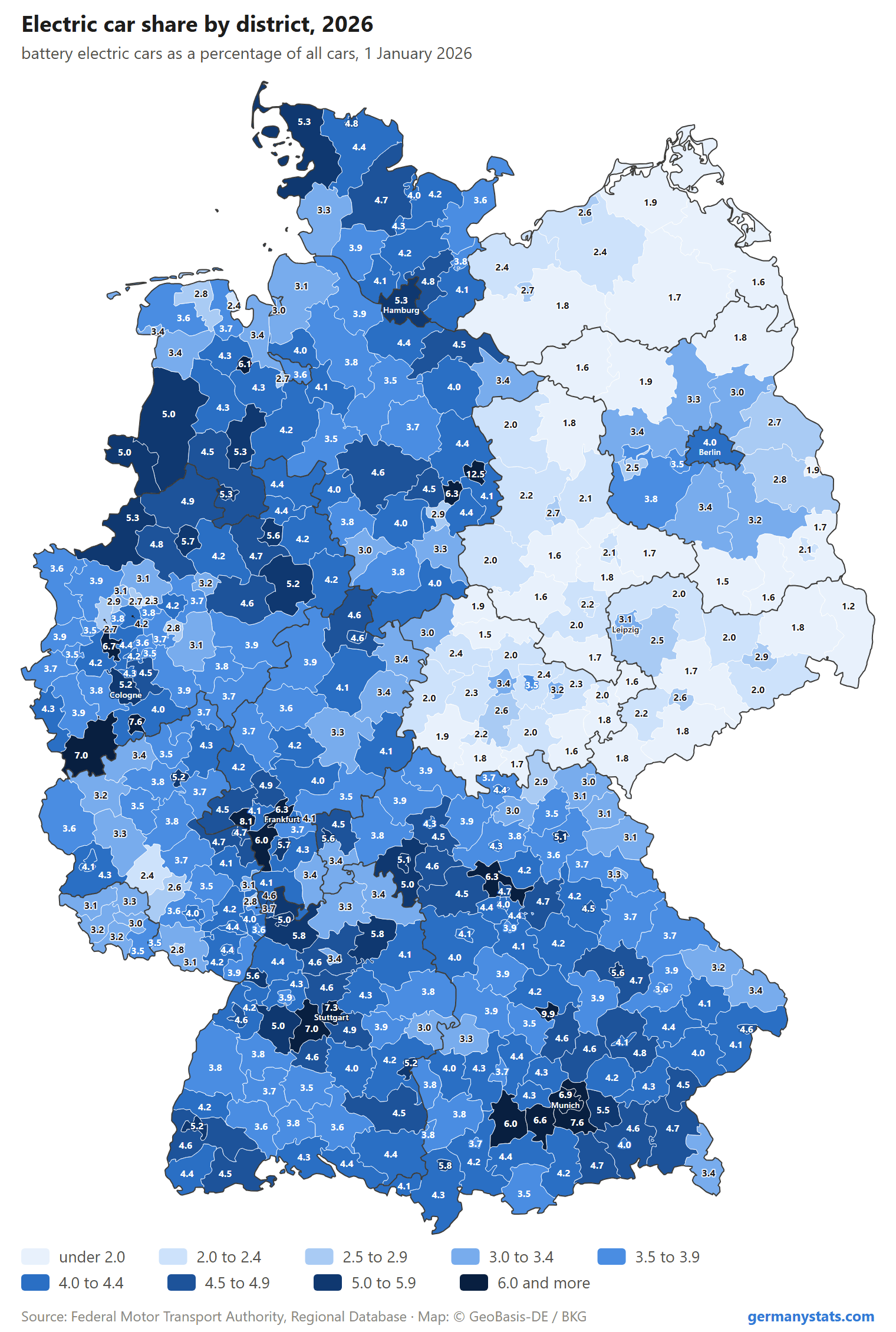
Electric car share by district: map of Germany
The highest shares are found in Wolfsburg (12.5 %), Ingolstadt (9.9 %) and Wiesbaden (8.1 %). Company cars play a big role here: vehicles are counted where their owner is registered, and carmakers, leasing companies and large employers register many company cars at their location. The largest number of electric cars is in Munich (54,695). 41 districts have a share of 5 % or more, 33 are below 2 % – all of them in eastern Germany, where incomes are lower and large company fleets are rarer.
Highest electric car share
| District | Share | EVs |
|---|---|---|
| Wolfsburg (city) | 12.5 % | 15,832 |
| Ingolstadt (city) | 9.9 % | 10,294 |
| Wiesbaden (city) | 8.1 % | 18,047 |
| Bonn (city) | 7.6 % | 13,368 |
| Munich (district) | 7.6 % | 19,003 |
| Stuttgart (city) | 7.3 % | 21,837 |
| Euskirchen (district) | 7.0 % | 11,850 |
| Böblingen (district) | 7.0 % | 18,590 |
| Munich (city) | 6.9 % | 54,695 |
| Düsseldorf (city) | 6.7 % | 22,089 |
Lowest electric car share
| District | Share | EVs |
|---|---|---|
| Görlitz (district) | 1.2 % | 1,783 |
| Kyffhäuserkreis | 1.5 % | 658 |
| Elbe-Elster (district) | 1.5 % | 956 |
| Oberspreewald-Lausitz (district) | 1.6 % | 1,021 |
| Saale-Orla-Kreis | 1.6 % | 790 |
| Altenburger Land (district) | 1.6 % | 819 |
| Mansfeld-Südharz (district) | 1.6 % | 1,270 |
| Salzlandkreis | 1.6 % | 1,704 |
Electric cars by federal state
Hamburg (5.3 %), Bavaria (4.7 %) and Baden-Württemberg (4.6 %) have the highest shares; Saxony-Anhalt has the lowest (2.0 %). In absolute numbers, most electric cars are registered in North Rhine-Westphalia and Bavaria.

| State | Electric cars | Share | Hybrid share | Share 2020 |
|---|---|---|---|---|
| Hamburg | 42,674 | 5.3 % | 11.8 % | 0.4 % |
| Bavaria | 395,271 | 4.7 % | 9.4 % | 0.4 % |
| Baden-Württemberg | 322,060 | 4.6 % | 9.2 % | 0.4 % |
| Hesse | 179,213 | 4.6 % | 10.4 % | 0.3 % |
| Lower Saxony | 221,823 | 4.4 % | 7.3 % | 0.3 % |
| North Rhine-Westphalia | 454,782 | 4.3 % | 9.0 % | 0.3 % |
| Schleswig-Holstein | 74,561 | 4.2 % | 7.3 % | 0.3 % |
| Berlin | 48,888 | 4.0 % | 11.5 % | 0.4 % |
| Rhineland-Palatinate | 102,047 | 3.8 % | 8.0 % | 0.2 % |
| Bremen | 10,643 | 3.5 % | 9.1 % | 0.3 % |
| Saarland | 21,056 | 3.2 % | 8.9 % | 0.2 % |
| Brandenburg | 41,653 | 2.8 % | 8.0 % | 0.2 % |
| Thuringia | 26,937 | 2.3 % | 7.8 % | 0.3 % |
| Saxony | 47,668 | 2.2 % | 7.6 % | 0.2 % |
| Mecklenburg-Western Pomerania | 18,347 | 2.1 % | 7.1 % | 0.1 % |
| Saxony-Anhalt | 24,247 | 2.0 % | 7.2 % | 0.1 % |
Related: Electricity prices in Germany, Solar power in Germany and Wind turbines in Germany.
Frequently asked questions
How many electric cars are there in Germany?
On 1 January 2026, 2,034,260 battery electric cars were registered, plus 4,362,563 hybrids, of which 1,122,958 were plug-in hybrids.
What percentage of cars in Germany are electric?
4.1 % of all passenger cars were battery electric on 1 January 2026. Including all hybrids, the share was 12.9 %.
Where in Germany are electric cars most common?
Wolfsburg has the highest share (12.5 %), largely because of company cars. Among the federal states, Hamburg leads with 5.3 %. The largest number of electric cars is registered in Munich.
How many diesel cars are left in Germany?
13,385,662 diesel cars were registered on 1 January 2026, 27.0 % of the fleet. The diesel share peaked at 32.9 % in 2017.
Do hybrids count as electric cars?
Not in these figures. Only battery electric cars count as electric. Hybrids, including plug-in hybrids, also have a combustion engine and are shown separately.