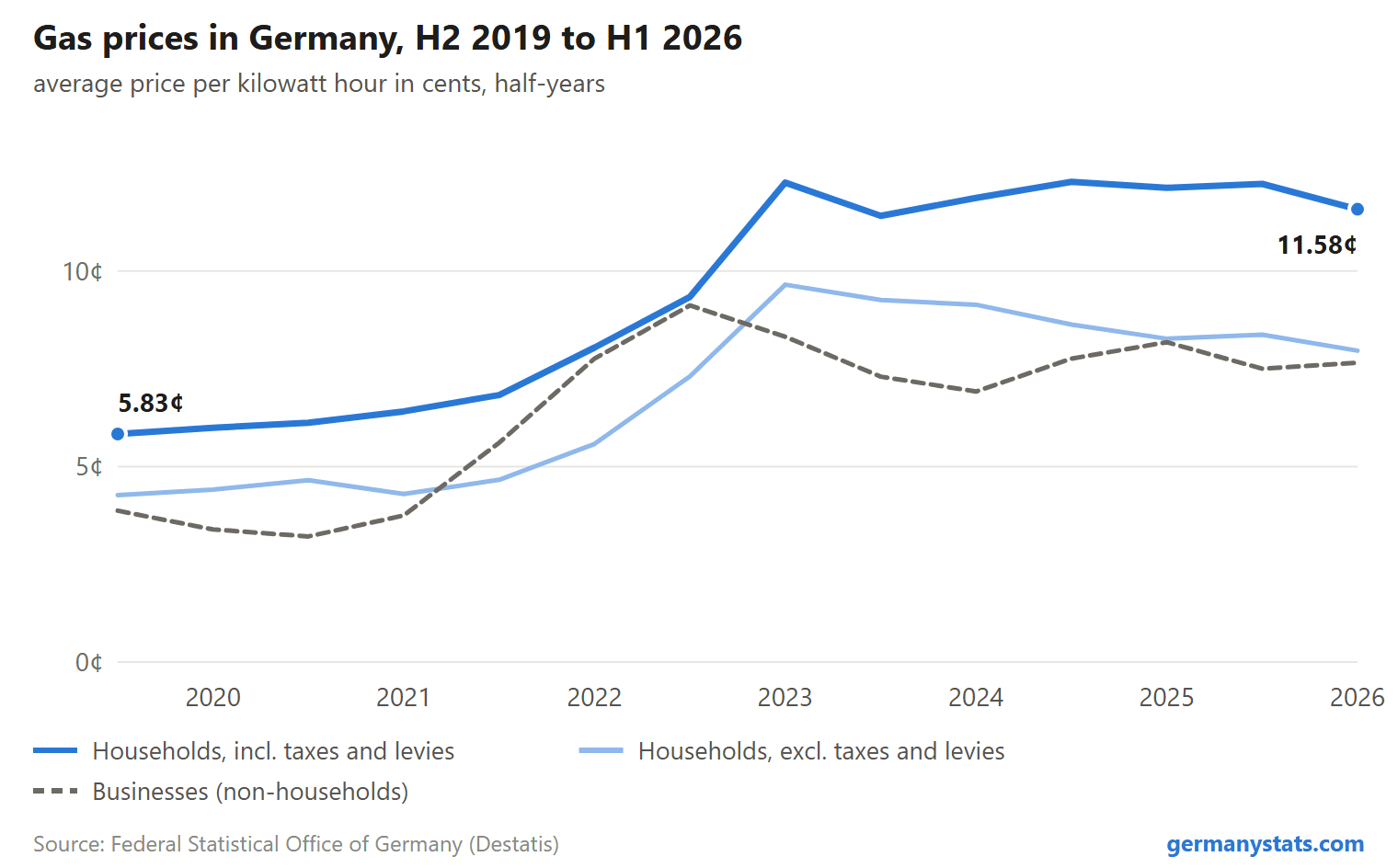
In short: In the first half of 2026, private households in Germany paid an average of 11.58 cents per kilowatt hour of natural gas, including all taxes, levies and surcharges (a year earlier: 12.13 cents). That is almost twice as much as in the second half of 2019 (5.83 cents). The highest half-year price was 12.28 cents in the second half of 2024. Since 1991, household gas prices have risen by 251 %, consumer prices overall by 97 %.
Household gas prices since 2019
Until 2021, households paid an average of 6 to 7 cents per kilowatt hour for natural gas. When Russian supplies stopped in 2022, wholesale prices soared; for households the increase arrived with a delay because of long-term contracts. Since 2023 the price has been above 11 cents and, unlike electricity, has hardly come down: in the first half of 2026 it was 11.58 cents. Businesses pay an average of 7.65 cents; their prices follow the wholesale market more quickly and fluctuated much more during the crisis.
| Half-year | Households | excl. taxes and levies | Businesses |
|---|---|---|---|
| H1 2026 | 11.58 cents | 7.96 cents | 7.65 cents |
| H2 2025 | 12.23 cents | 8.37 cents | 7.50 cents |
| H1 2025 | 12.13 cents | 8.27 cents | 8.18 cents |
| H2 2024 | 12.28 cents | 8.63 cents | 7.76 cents |
| H1 2024 | 11.87 cents | 9.14 cents | 6.92 cents |
| H2 2023 | 11.41 cents | 9.26 cents | 7.30 cents |
| H1 2023 | 12.26 cents | 9.65 cents | 8.32 cents |
| H2 2022 | 9.34 cents | 7.31 cents | 9.12 cents |
| H1 2022 | 8.04 cents | 5.58 cents | 7.76 cents |
| H2 2021 | 6.83 cents | 4.66 cents | 5.61 cents |
| H1 2021 | 6.41 cents | 4.30 cents | 3.75 cents |
| H2 2020 | 6.12 cents | 4.65 cents | 3.21 cents |
| H1 2020 | 5.99 cents | 4.41 cents | 3.39 cents |
| H2 2019 | 5.83 cents | 4.27 cents | 3.87 cents |
What makes up the gas price?
The gas price consists of procurement and supply costs, network charges, and taxes, levies and surcharges (energy tax, VAT, CO₂ price, concession fees and surcharges). Procurement costs more than doubled from 2.78 cents (2019) to as much as 7.53 cents and stood at 5.97 cents in 2025. The government share also rose, from 1.56 cents to 3.86 cents – mainly because of the CO₂ price on heating gas introduced in 2021 and raised step by step since, and the end of the temporary VAT cut (7 % from October 2022 to March 2024). Network costs rose from 1.49 cents to 2.35 cents.

| Year | Energy and supply | Network costs | Taxes, levies | Price |
|---|---|---|---|---|
| 2019 | 2.78 cents | 1.49 cents | 1.56 cents | 5.83 cents |
| 2020 | 2.92 cents | 1.58 cents | 1.54 cents | 6.04 cents |
| 2021 | 2.92 cents | 1.53 cents | 2.13 cents | 6.58 cents |
| 2022 | 4.76 cents | 1.48 cents | 2.29 cents | 8.53 cents |
| 2023 | 7.53 cents | 1.96 cents | 2.43 cents | 11.92 cents |
| 2024 | 6.95 cents | 1.97 cents | 3.14 cents | 12.06 cents |
| 2025 | 5.97 cents | 2.35 cents | 3.86 cents | 12.18 cents |
Gas heating bills: what does a household pay a year?
How much gas a household needs depends mainly on floor space, insulation and the heating system; a rough guide is 100 to 160 kWh per square metre a year. Households using less than 5,600 kWh paid an average of 15.17 cents in the first half of 2026, because the standing charge weighs more heavily; households using 5,600 to 55,599 kWh paid 11.56 cents. This gives the following estimates:
| Example | Annual use | Price per kWh | Annual bill | per month |
|---|---|---|---|---|
| hot water only or small flat | 5,000 kWh | 15.17 cents | €759 | €63 |
| flat, about 80 m² | 12,000 kWh | 11.56 cents | €1,387 | €116 |
| house, about 140 m² | 20,000 kWh | 11.56 cents | €2,312 | €193 |
| large older house | 30,000 kWh | 11.56 cents | €3,468 | €289 |
| Consumption band | Price H1 2026 |
|---|---|
| under 5,600 kWh | 15.17 cents |
| 5,600 to 55,599 kWh | 11.56 cents |
| 55,600 kWh and more | 10.92 cents |
New contracts and default supply tariffs can differ considerably from the average. To estimate your own costs, multiply the annual consumption from your last bill by the unit price and add the standing charge.
Gas prices since 1991 compared with inflation
There are no official average prices in cents before 2019, but there is a consumer price index for gas. According to it, household gas prices have risen by 251 % since 1991, consumer prices overall by 97 %. Until 2021 prices moved in waves because gas prices were long linked to the oil price; the biggest jump came in 2022 with +48.2 % in one year.

| Year | Gas (1991 = 100) | Change on previous year | Consumer prices (1991 = 100) |
|---|---|---|---|
| 1991 | 100 | – | 100 |
| 1995 | 96 | −3.1 % | 115 |
| 2000 | 112 | +16.2 % | 122 |
| 2005 | 150 | +10.3 % | 132 |
| 2008 | 197 | +8.9 % | 140 |
| 2010 | 177 | −8.6 % | 142 |
| 2015 | 195 | −1.5 % | 153 |
| 2020 | 189 | +1.2 % | 162 |
| 2022 | 291 | +48.2 % | 178 |
| 2023 | 366 | +25.8 % | 189 |
| 2025 | 351 | −1.9 % | 197 |
Related: Electricity prices in Germany, Inflation rate in Germany and Rents in Germany.
Frequently asked questions
What is the current gas price in Germany?
In the first half of 2026, private households paid an average of 11.58 cents per kilowatt hour of natural gas, including all taxes, levies and surcharges.
How much does 1 kWh of gas cost in Germany?
On average 11.58 cents (H1 2026). Households with very low consumption (under 5,600 kWh) paid 15.17 cents, households with high consumption 10.92 cents.
How much does it cost to heat a flat with gas?
At 12,000 kWh a year, roughly a flat of 80 m², and 11.56 cents per kWh, about €1,387 a year or €116 a month (estimate based on official average prices).
When was gas most expensive in Germany?
The highest half-year price for households was 12.28 cents per kilowatt hour in the second half of 2024.
Why have gas prices risen?
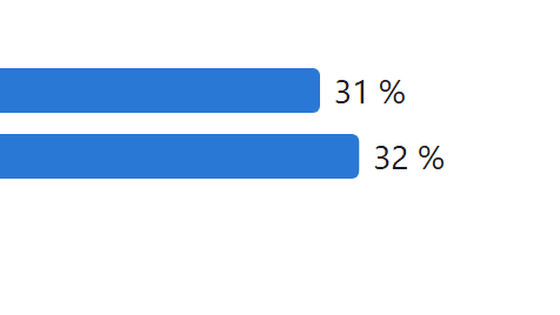
Mainly because of higher procurement costs since the 2022 energy crisis, plus the rising CO₂ price and higher network charges. In 2025, 49 % of the price went on energy and supply, 19 % on network costs and 32 % on taxes, levies and surcharges.
Are there gas prices by German state?
No. Official statistics only publish gas prices for Germany as a whole.