In short: Bremerhaven had 118,502 inhabitants on 31 December 2025, ranking 67th among Germany's major cities. Since 1995 the population has fallen by 9.1 %. The average age is 43.3 years (Germany: 45.0), 22.6 % of residents are foreign nationals, and the unemployment rate was 14.5 % in 2025.
Population of Bremerhaven
Bremerhaven had 118,502 inhabitants at the end of 2025, 50.1 % of them women; in 1995 there were 130,400. It peaked at 130,400 in 1995. The lowest figure was 108,139 in 2011. For comparison, Germany as a whole grew by 2.0 % over the same period. In 2024, 713 more people moved in than out (+6.0 per 1,000 inhabitants); among 18- to 24-year-olds the balance was +350, among people aged 65 and over −123. The breaks in 2011 and 2022 are due to the censuses, after which population figures were recalculated.
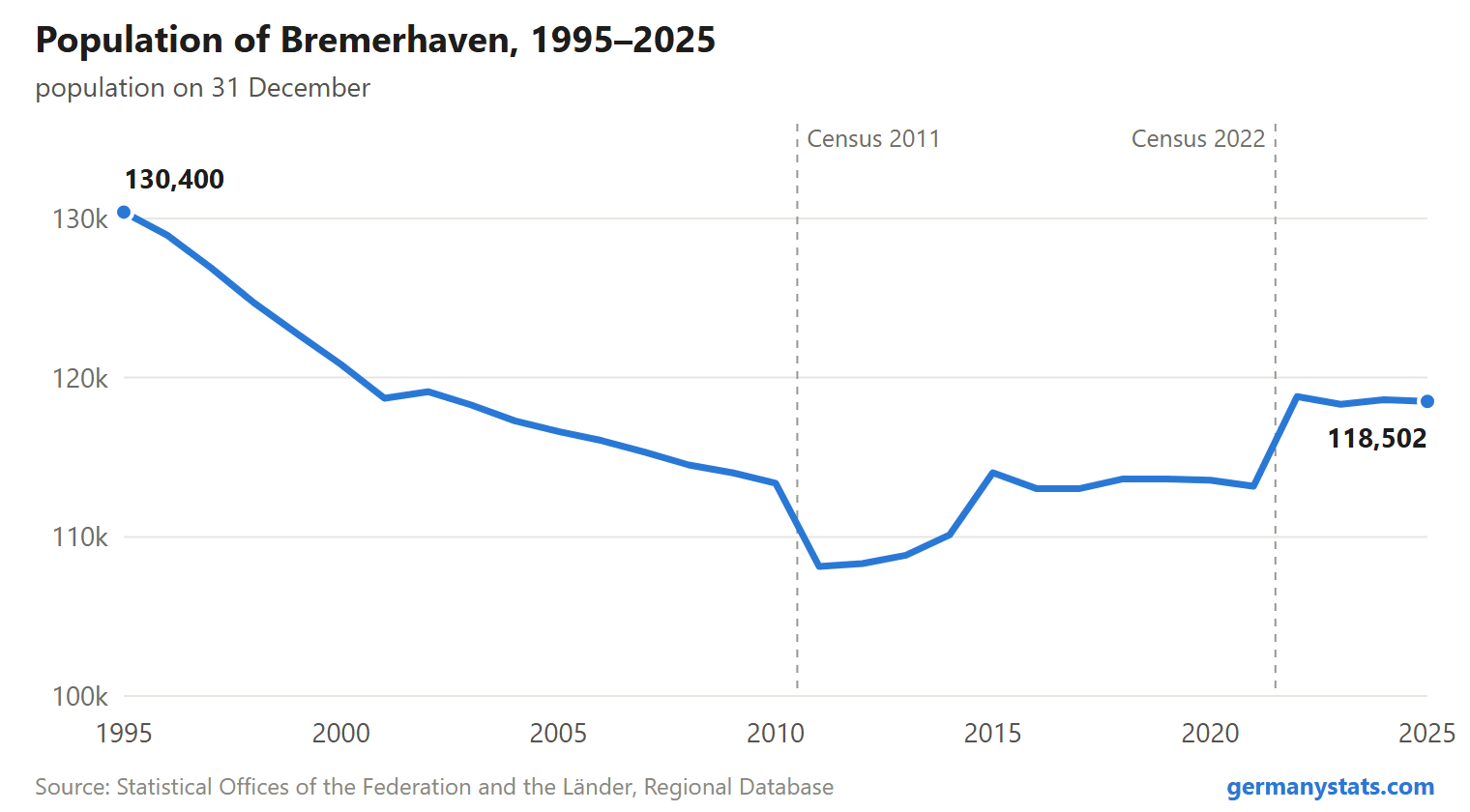
| 31 Dec | Population | Change on previous year |
|---|---|---|
| 1995 | 130,400 | – |
| 2000 | 120,822 | −1,913 |
| 2005 | 116,615 | −666 |
| 2010 | 113,366 | −665 |
| 2011 | 108,139 | −5,227 |
| 2015 | 114,025 | +3,904 |
| 2020 | 113,557 | −86 |
| 2021 | 113,173 | −384 |
| 2022 | 118,811 | +5,638 |
| 2024 | 118,610 | +287 |
| 2025 | 118,502 | −108 |
Age structure: how old are people in Bremerhaven?
The average age in Bremerhaven was 43.3 years in 2025 and the median age 42.9 years – 1.7 years younger than the national average. Among the 71 major cities, Bremerhaven has the 40th youngest population. 26.1 % of residents are aged 20 to 39 (Germany: 24.2 %), 6.3 % are 80 or older (Germany: 7.1 %).

Men and women in Bremerhaven
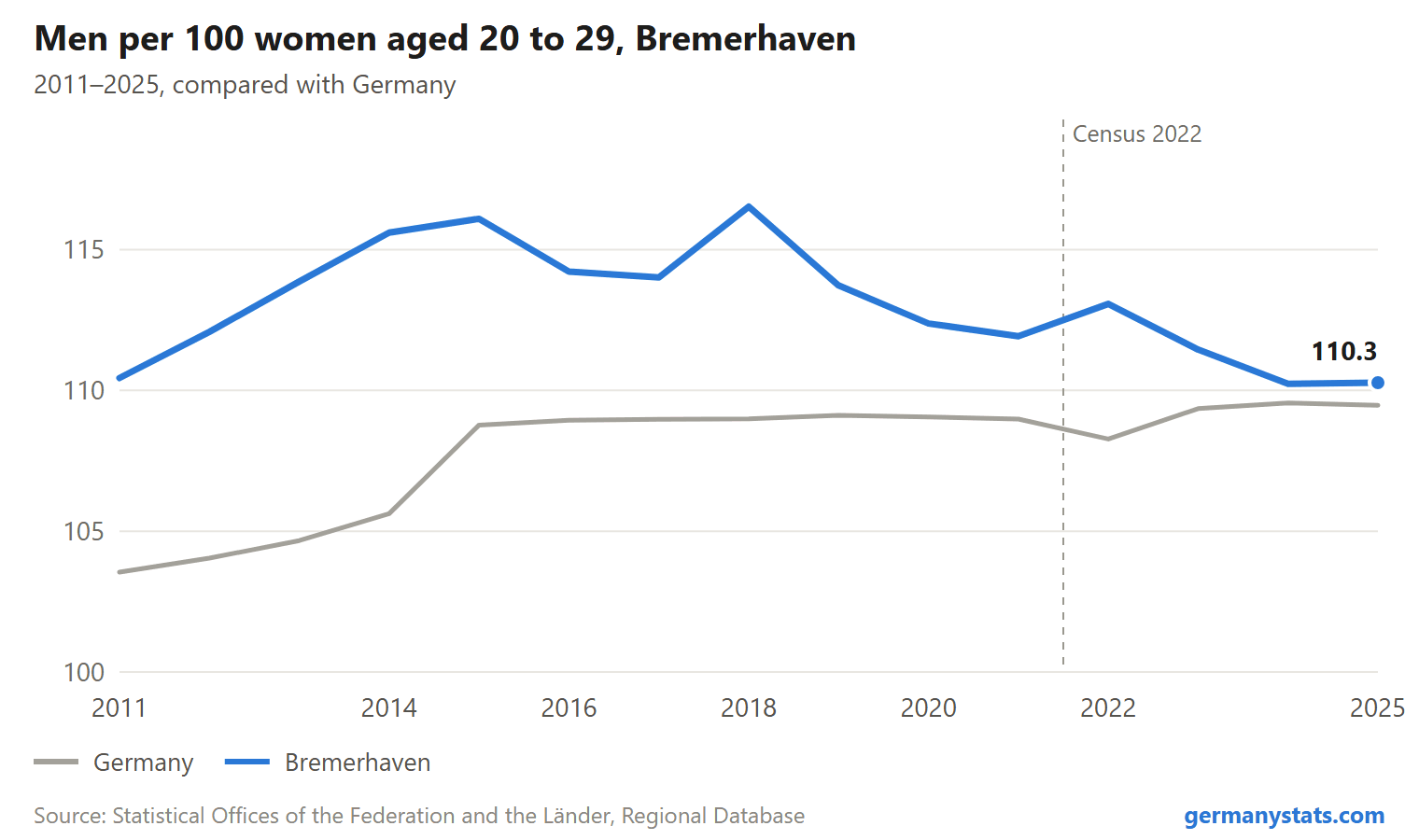
Overall, 50.1 % of residents are women. Among 20- to 29-year-olds there were 110.3 men per 100 women in Bremerhaven in 2025 (Germany: 109.5). There are clearly more young men than young women – typical of cities with technical universities, industry or many young immigrants. In 2011 the figure was 110.4. More on the page Gender ratio in Germany.
Foreign nationals in Bremerhaven
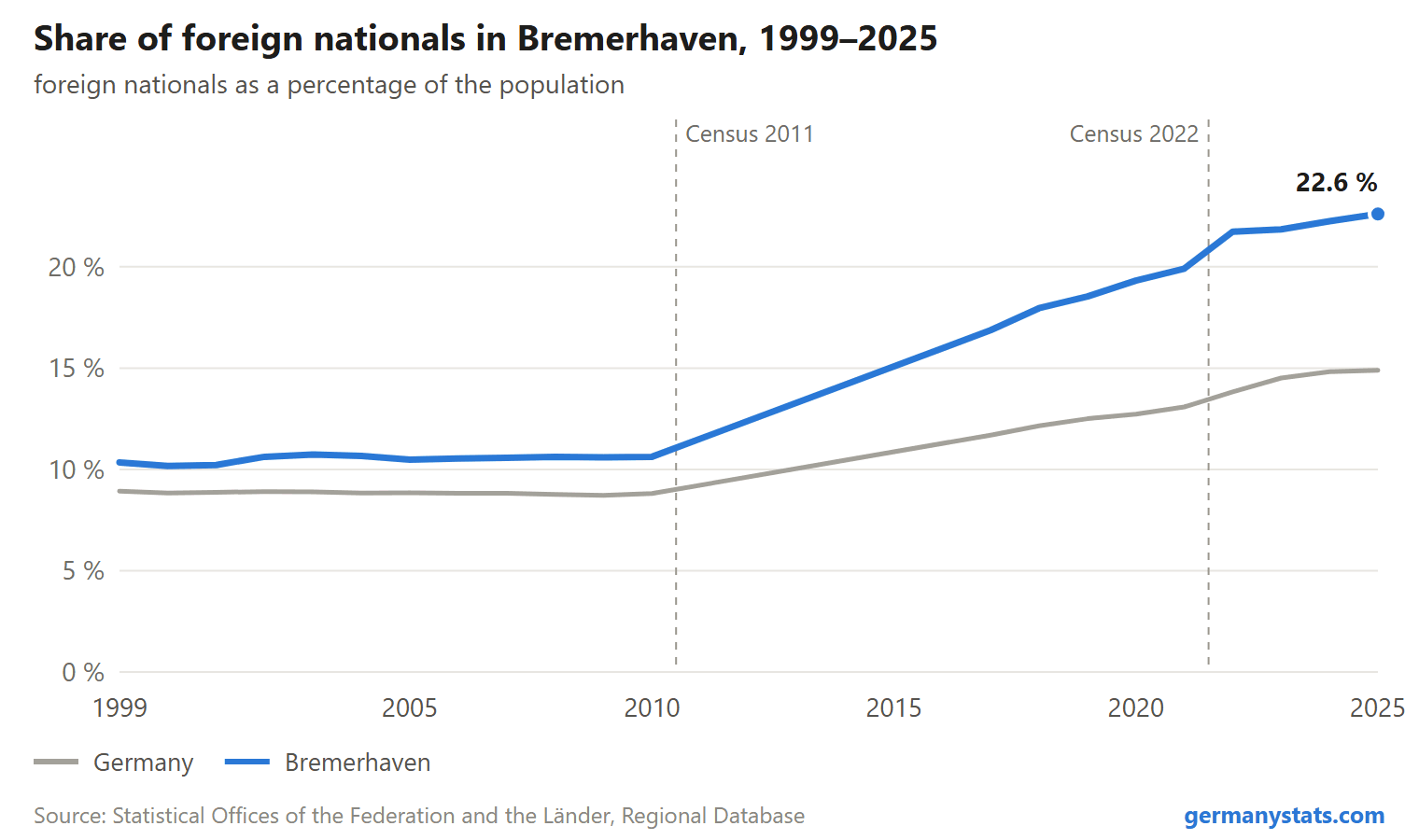
At the end of 2025, 26,792 residents of Bremerhaven did not hold German citizenship – 22.6 % (Germany: 14.9 %). In 1999 the share was 10.3 %. Among the 71 major cities, Bremerhaven has the 24th highest share of foreign nationals. 8,880 of them were people seeking protection at the end of 2025 (74.9 per 1,000 inhabitants).
Jobs and income in Bremerhaven
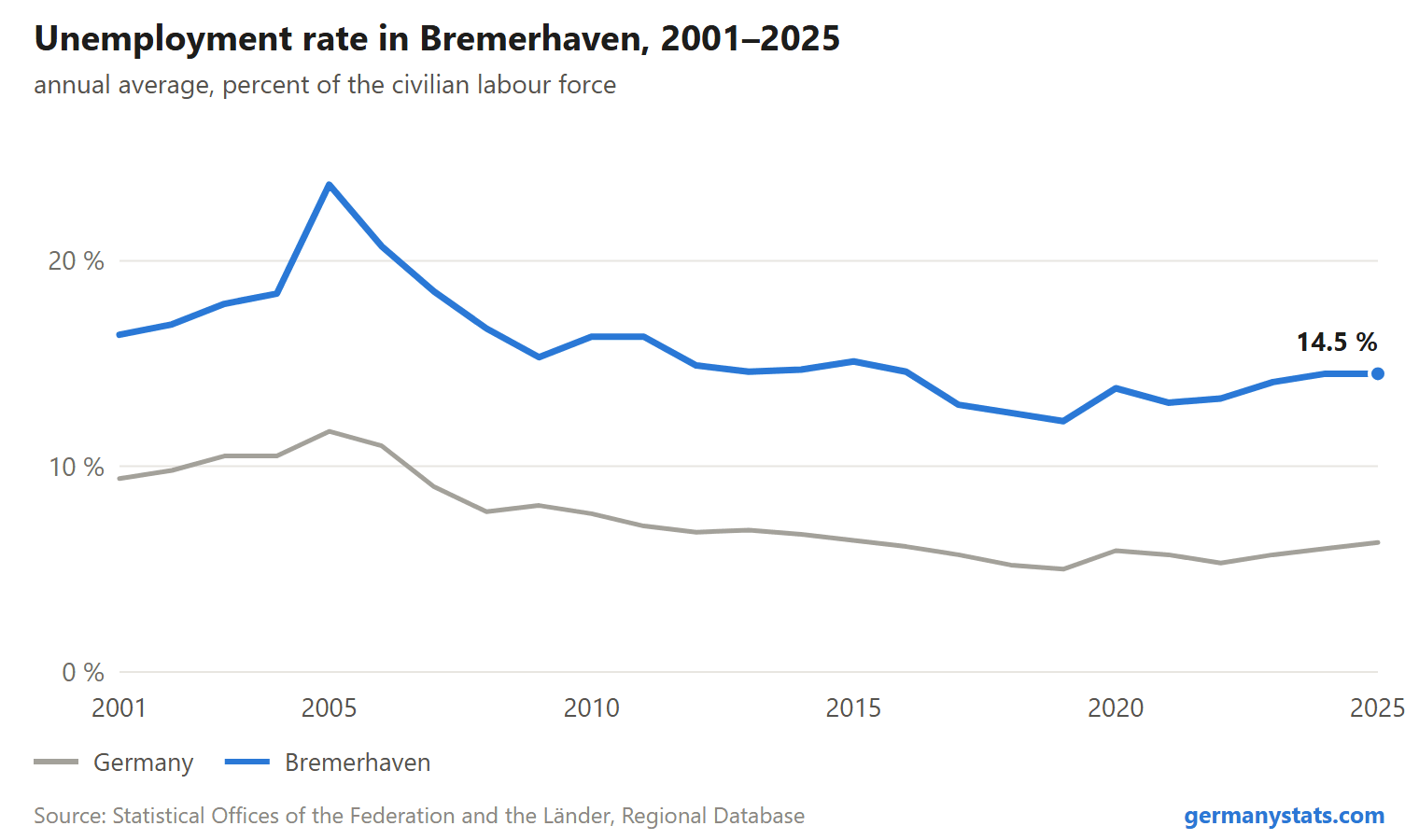
The unemployment rate averaged 14.5 % in 2025 (Germany: 6.3 %), with 9,087 people registered as unemployed on average. 42 % of them were long-term unemployed, 37 % foreign nationals and 9 % under 25. At the end of 2024, 19,578 people received Bürgergeld (basic income support), 16.5 % of residents (Germany: 6.5 %). Household disposable income was €22,433 per resident in 2024, 25 % below the national average. GDP per resident was €43,523 in 2024 (Germany: €51,834). 14.9 % of employees subject to social insurance have a university degree (Germany: 20.5 %).
| Indicator | Bremerhaven | Germany |
|---|---|---|
| Unemployment rate 2025 | 14.5 % | 6.3 % |
| Bürgergeld recipients 2024 | 16.5 % | 6.5 % |
| Disposable income per resident 2024 | €22,433 | €30,069 |
| Compensation per employee 2024 | €55,568 | €55,625 |
| GDP per resident 2024 | €43,523 | €51,834 |
| Employees with a degree 2025 | 14.9 % | 20.5 % |
| Business units per 1,000 residents 2024 | 33.8 | 46.0 |
Housing, transport and tourism
Bremerhaven had 65,364 dwellings at the end of 2025, with an average of 42.9 m² of living space per resident in residential buildings (Germany: 48.5 m²). On 1 January 2026, 52,986 cars were registered, 447 per 1,000 residents (Germany: 593); 3.0 % of them were battery electric (Germany: 4.1 %). Hotels and other accommodation recorded 472,074 overnight stays in 2025, 4.0 per resident. The fertility rate was 1.48 children per woman in 2024 (Germany: 1.35).
Federal election 2025 in Bremerhaven
Turnout in Bremerhaven at the 2025 federal election was 71.1 %. The SPD won the most second votes with 25.0 %. The table also shows the 2021 result.
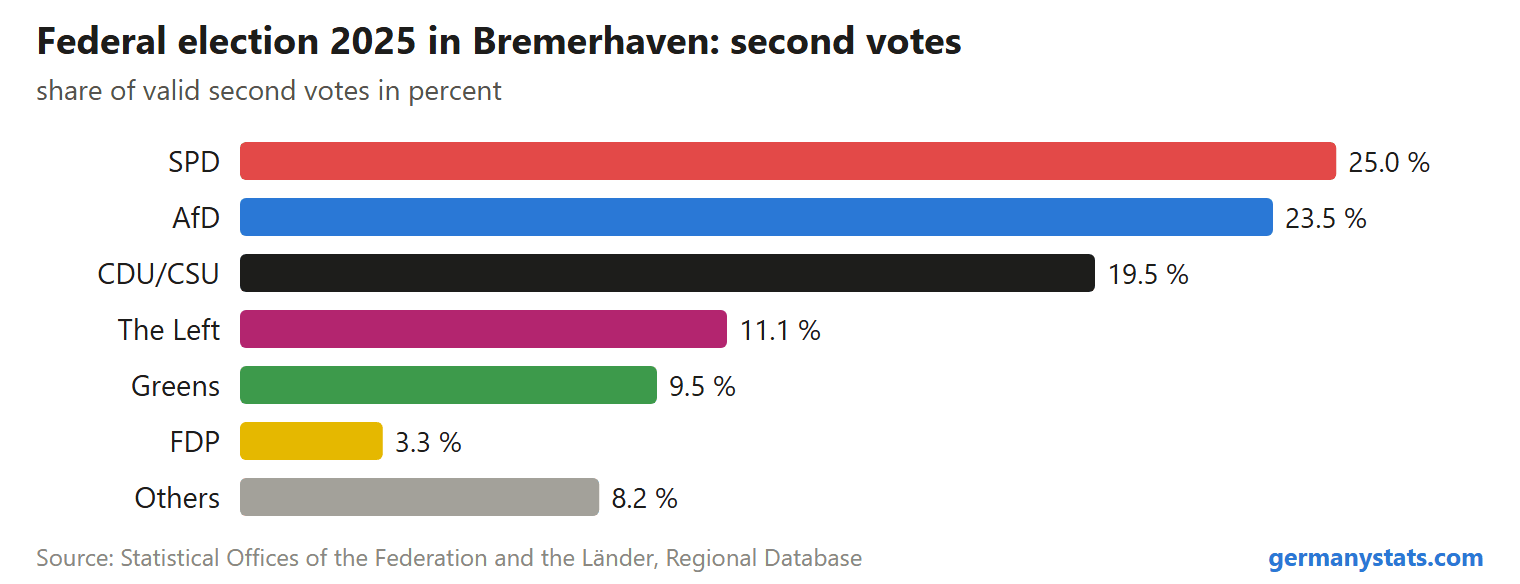
| Party | Second votes 2025 | Second votes 2021 |
|---|---|---|
| SPD | 25.0 % | 36.5 % |
| AfD | 23.5 % | 10.6 % |
| CDU/CSU | 19.5 % | 17.4 % |
| The Left | 11.1 % | 5.5 % |
| Greens | 9.5 % | 14.1 % |
| FDP | 3.3 % | 8.4 % |
Bremerhaven compared with Bremen and Germany
| Indicator | Bremerhaven | Bremen | Germany |
|---|---|---|---|
| Population | 118,502 | 706,915 | 83,467,117 |
| Change since 1995 | −9.1 % | +4.0 % | +2.0 % |
| Average age | 43.3 | 43.2 | 45.0 |
| Foreign nationals | 22.6 % | 23.3 % | 14.9 % |
| Unemployment rate | 14.5 % | 11.5 % | 6.3 % |
| Bürgergeld rate | 16.5 % | 13.5 % | 6.5 % |
Figures for every district are on the pages Population of Germany, Average age, Foreigners in Germany, Unemployment rate and Bürgergeld – each with a map of all districts.
Frequently asked questions about Bremerhaven
What is the population of Bremerhaven?
Bremerhaven had 118,502 inhabitants on 31 December 2025 (official figures based on the 2022 census).
Is Bremerhaven growing?
Since 1995 the population has fallen by 9.1 %.
What share of Bremerhaven's population are foreigners?
22.6 % (end of 2025); 26,792 residents did not hold German citizenship.
What is the unemployment rate in Bremerhaven?
The annual average unemployment rate was 14.5 % in 2025.
What is the average age in Bremerhaven?
43.3 years (2025).
Are there more young men or young women in Bremerhaven?
Among 20- to 29-year-olds there were 110.3 men per 100 women in 2025 (Germany: 109.5).