In short: Dresden had 562,764 inhabitants on 31 December 2025, ranking 12th among Germany's major cities. Since 1995 the population has grown by 13.6 %. The average age is 43.8 years (Germany: 45.0), 12.0 % of residents are foreign nationals, and the unemployment rate was 7.0 % in 2025.
Population of Dresden
Dresden had 562,764 inhabitants at the end of 2025, 50.4 % of them women; in 1995 there were 495,424. It peaked at 564,904 in 2024. The lowest figure was 476,668 in 1999. For comparison, Germany as a whole grew by 2.0 % over the same period. In 2024, 3,790 more people moved in than out (+6.7 per 1,000 inhabitants); among 18- to 24-year-olds the balance was +3,988, among people aged 65 and over −155. The breaks in 2011 and 2022 are due to the censuses, after which population figures were recalculated.
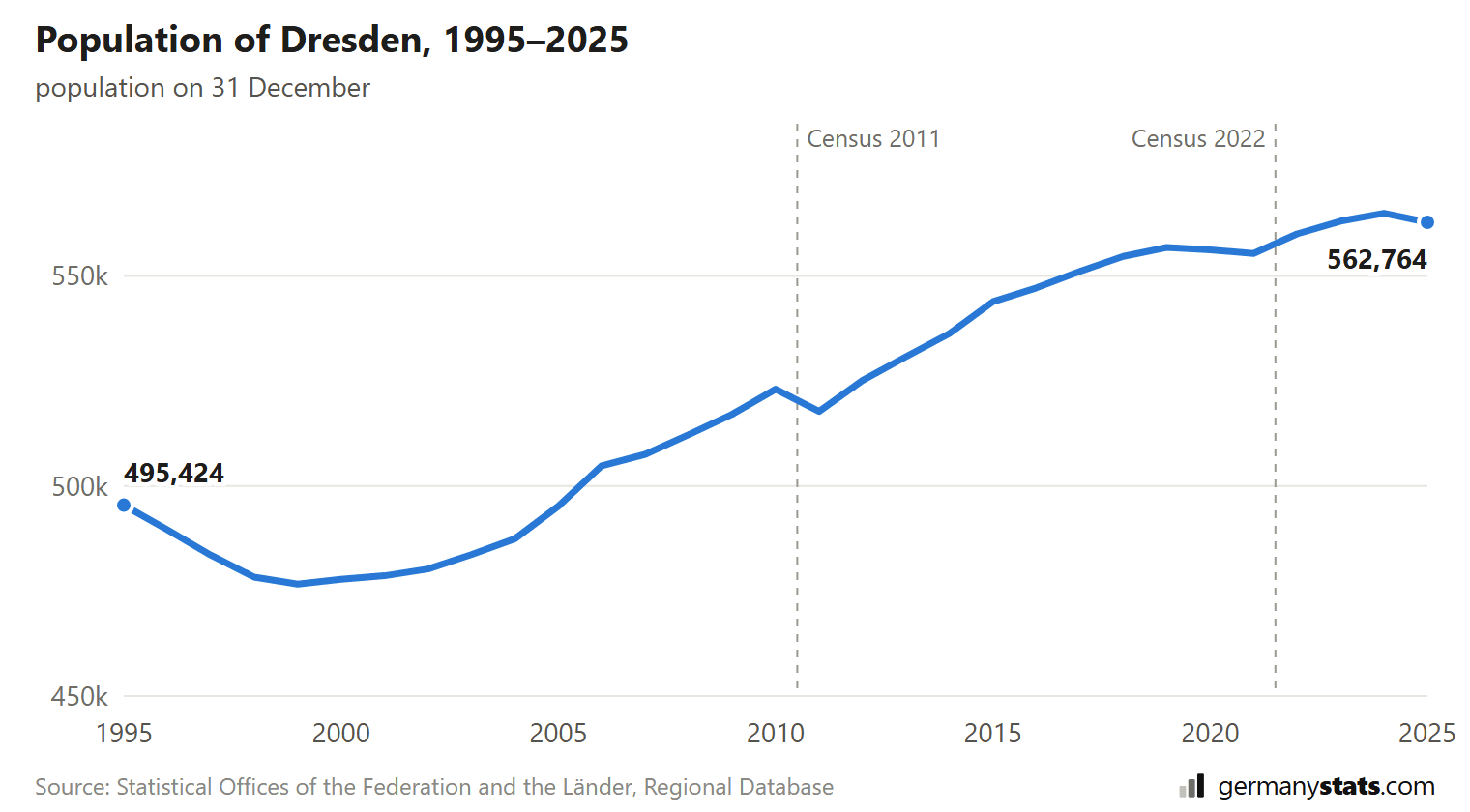
| 31 Dec | Population | Change on previous year |
|---|---|---|
| 1995 | 495,424 | – |
| 2000 | 477,807 | +1,139 |
| 2005 | 495,181 | +7,760 |
| 2010 | 523,058 | +6,006 |
| 2011 | 517,765 | −5,293 |
| 2015 | 543,825 | +7,517 |
| 2020 | 556,227 | −553 |
| 2021 | 555,351 | −876 |
| 2022 | 559,986 | +4,635 |
| 2024 | 564,904 | +1,885 |
| 2025 | 562,764 | −2,140 |
Age structure: how old are people in Dresden?
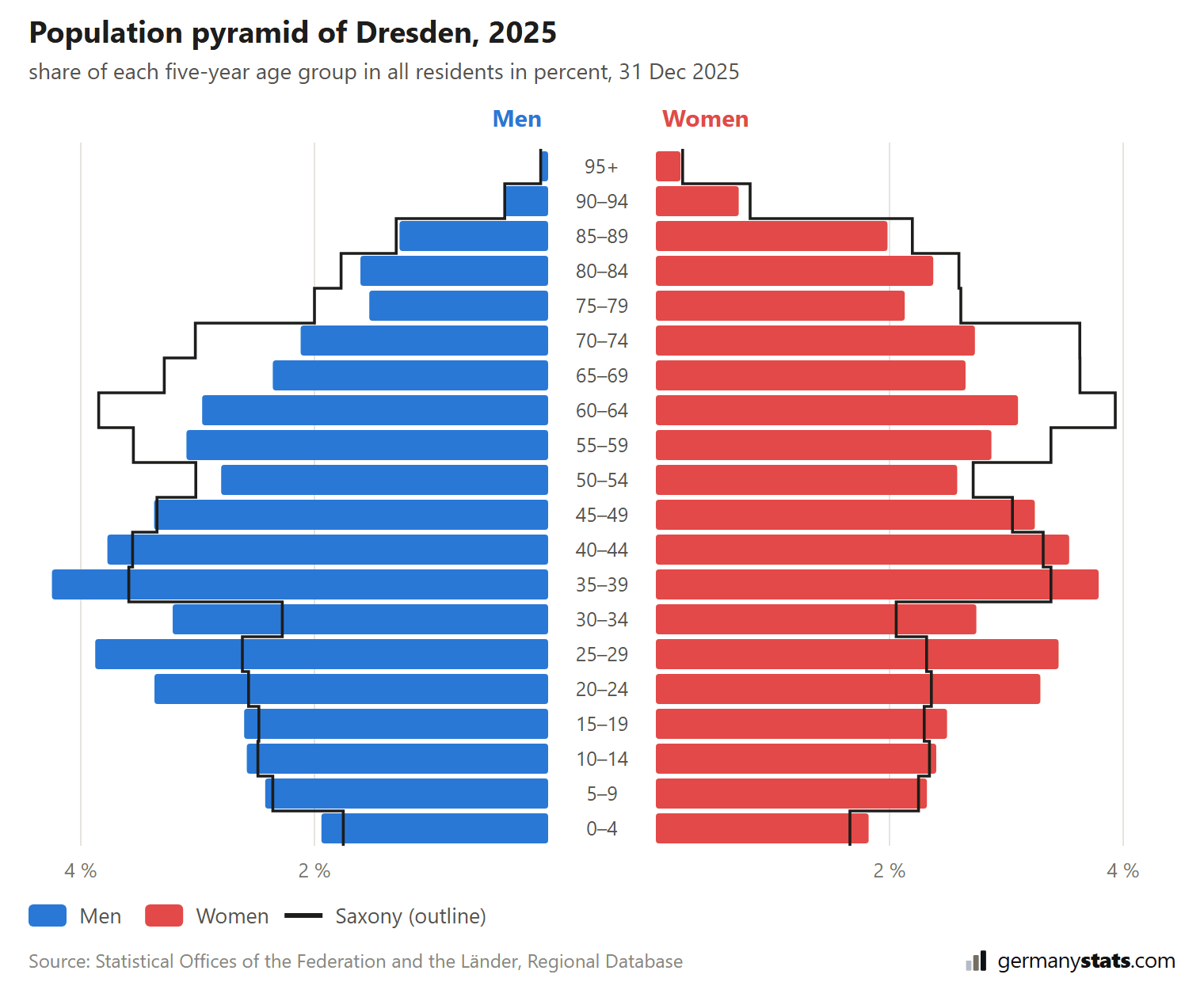
The average age in Dresden was 43.8 years in 2025 and the median age 42.3 years – 1.2 years younger than the national average. Among the 71 major cities, Dresden has the 46th youngest population. 28.0 % of residents are aged 20 to 39 (Germany: 24.2 %), 8.6 % are 80 or older (Germany: 7.1 %).
Population pyramid of Dresden
The population pyramid shows how residents are distributed across age groups – men on the left, women on the right, children at the bottom and the very old at the top. The largest group are 35- to 39-year-olds with 8.0 % of all residents. The black line shows Saxony for comparison: where the bars extend beyond the line, that age group is more strongly represented in Dresden.
| Age group | Dresden | Saxony |
|---|---|---|
| under 20 | 18.6 % | 17.6 % |
| 20 to 29 | 14.0 % | 9.9 % |
| 30 to 49 | 27.9 % | 24.6 % |
| 50 to 64 | 17.4 % | 20.4 % |
| 65 to 79 | 13.5 % | 18.2 % |
| 80 and over | 8.6 % | 9.3 % |
Men and women in Dresden
Overall, 50.4 % of residents are women. Among 20- to 29-year-olds there were 107.6 men per 100 women in Dresden in 2025 (Germany: 109.5). The ratio is fairly balanced. In 2011 the figure was 106.0. More on the page Gender ratio in Germany.

Foreign nationals in Dresden
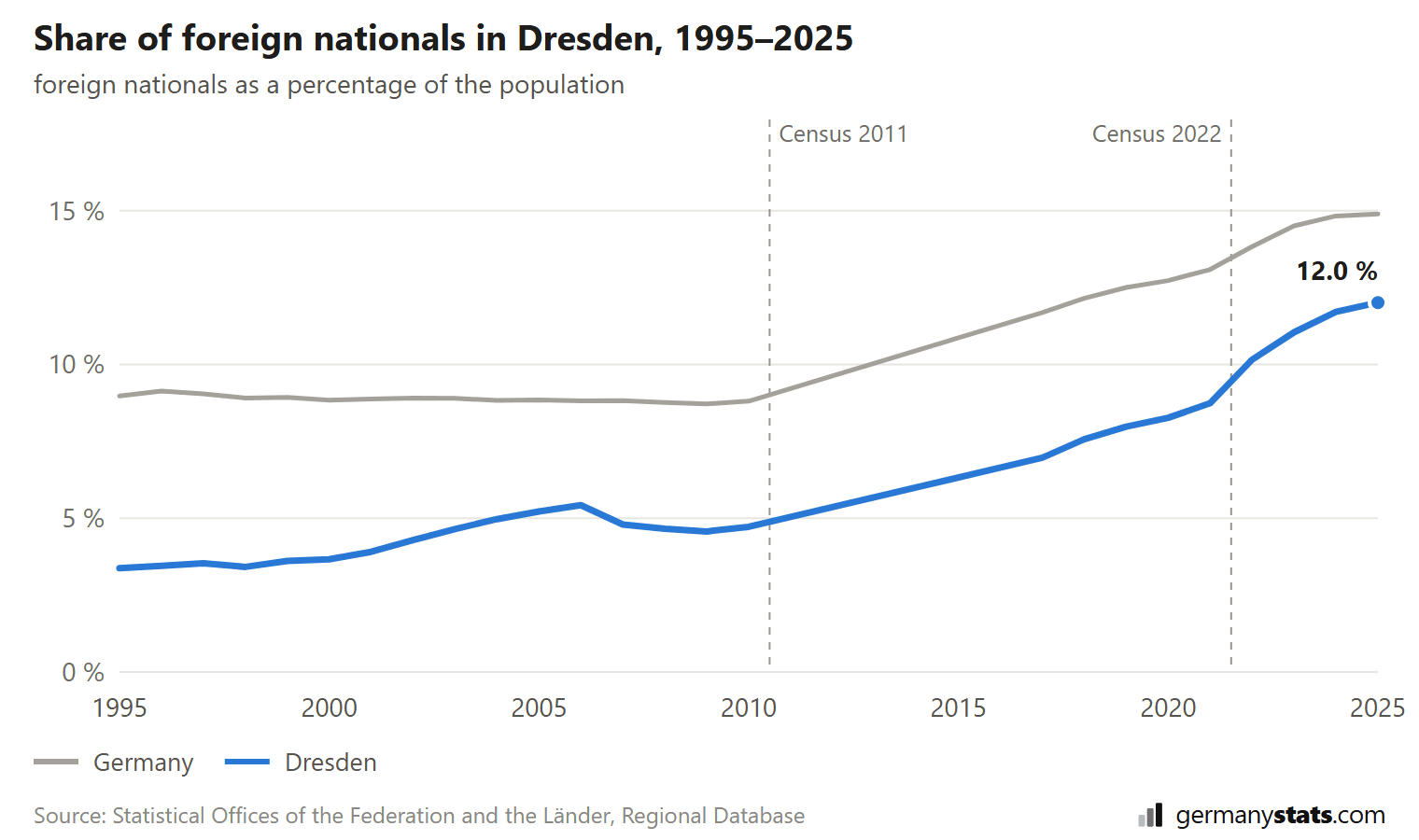
At the end of 2025, 67,603 residents of Dresden did not hold German citizenship – 12.0 % (Germany: 14.9 %). In 1995 the share was 3.4 %. Among the 71 major cities, Dresden has the 69th highest share of foreign nationals. 24,370 of them were people seeking protection at the end of 2025 (43.3 per 1,000 inhabitants).
Jobs and income in Dresden
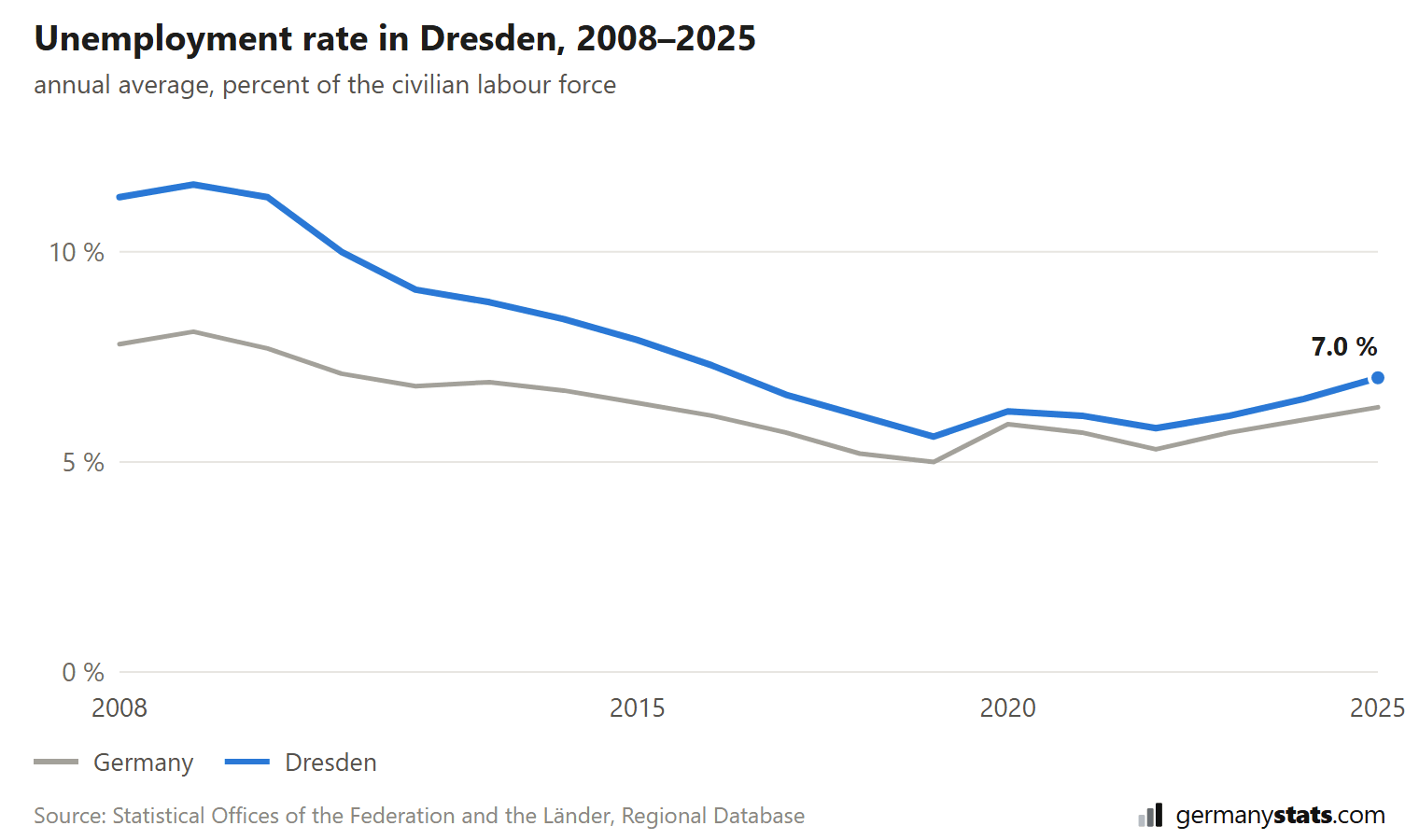
The unemployment rate averaged 7.0 % in 2025 (Germany: 6.3 %), with 22,103 people registered as unemployed on average. 35 % of them were long-term unemployed, 32 % foreign nationals and 10 % under 25. At the end of 2024, 37,544 people received Bürgergeld (basic income support), 6.6 % of residents (Germany: 6.5 %). Household disposable income was €26,784 per resident in 2024, 11 % below the national average. GDP per resident was €53,904 in 2024 (Germany: €51,834). 31.6 % of employees subject to social insurance have a university degree (Germany: 20.5 %).
| Indicator | Dresden | Germany |
|---|---|---|
| Unemployment rate 2025 | 7.0 % | 6.3 % |
| Bürgergeld recipients 2024 | 6.6 % | 6.5 % |
| Disposable income per resident 2024 | €26,784 | €30,069 |
| Compensation per employee 2024 | €54,049 | €55,625 |
| GDP per resident 2024 | €53,904 | €51,834 |
| Employees with a degree 2025 | 31.6 % | 20.5 % |
| Business units per 1,000 residents 2024 | 42.9 | 46.0 |
Housing, transport and tourism
Dresden had 325,447 dwellings at the end of 2025, with an average of 40.3 m² of living space per resident in residential buildings (Germany: 48.5 m²). On 1 January 2026, 229,638 cars were registered, 408 per 1,000 residents (Germany: 593); 2.9 % of them were battery electric (Germany: 4.1 %). Hotels and other accommodation recorded 4,571,518 overnight stays in 2025, 8.1 per resident. The fertility rate was 1.10 children per woman in 2024 (Germany: 1.35).
Federal election 2025 in Dresden
Turnout in Dresden at the 2025 federal election was 83.2 %. The AfD won the most second votes with 26.7 %. The table also shows the 2021 result.
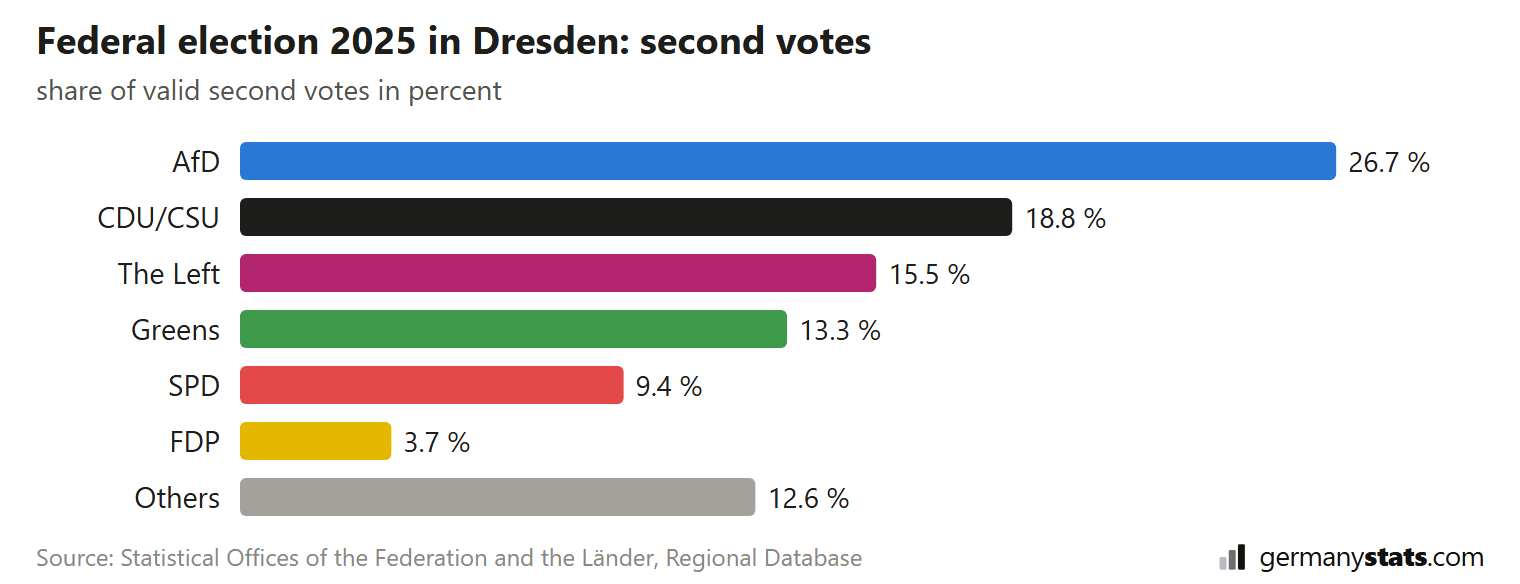
| Party | Second votes 2025 | Second votes 2021 |
|---|---|---|
| AfD | 26.7 % | 17.6 % |
| CDU/CSU | 18.8 % | 14.5 % |
| The Left | 15.5 % | 11.1 % |
| Greens | 13.3 % | 16.8 % |
| SPD | 9.4 % | 17.7 % |
| FDP | 3.7 % | 12.0 % |
Dresden compared with Saxony and Germany
| Indicator | Dresden | Saxony | Germany |
|---|---|---|---|
| Population | 562,764 | 4,026,599 | 83,467,117 |
| Change since 1995 | +13.6 % | −11.8 % | +2.0 % |
| Average age | 43.8 | 47.2 | 45.0 |
| Foreign nationals | 12.0 % | 8.4 % | 14.9 % |
| Unemployment rate | 7.0 % | 6.9 % | 6.3 % |
| Bürgergeld rate | 6.6 % | 6.0 % | 6.5 % |
Figures for every district are on the pages Population of Germany, Average age, Foreigners in Germany, Unemployment rate and Bürgergeld – each with a map of all districts.
Frequently asked questions about Dresden
What is the population of Dresden?
Dresden had 562,764 inhabitants on 31 December 2025 (official figures based on the 2022 census).
Is Dresden growing?
Since 1995 the population has grown by 13.6 %.
What share of Dresden's population are foreigners?
12.0 % (end of 2025); 67,603 residents did not hold German citizenship.
What is the unemployment rate in Dresden?
The annual average unemployment rate was 7.0 % in 2025.
What is the average age in Dresden?
43.8 years (2025).
Are there more young men or young women in Dresden?
Among 20- to 29-year-olds there were 107.6 men per 100 women in 2025 (Germany: 109.5).